A Day in the Life (Summer School Edition)

5:50 a.m.  I try to wake up and start my run before I realize what I’m doing. Sean stays in bed, letting the sun pink the walls slowly as he eases into the day. Usually by the time I wake up fully, the sun is just breaking over the trees and I’m smiling, halfway down the road. I try to push my distance a little every day, to run the length of that sorghum field, to circle that pole barn, to turn around at that road cut. This morning, I startled a young possum in the ditch and was myself startled by a rattlesnake, as big around as my bicep, curled dead in the road.
I come home, shower, and get dressed in my teacher uniform: usually a skirt, a t-shirt, flats, and earrings. Sean packs my laptop, a waterbottle and a banana in my bag and pops in a bagel for me. At 7:00, we’re out the door.

7:45 a.m.  Papers laid out, pencils sharpened, we’re in the cafeteria, watching the kids eat breakfast, breathless from the whirlwind of copying and tidying before class. At 8:00 we walk our groups to our respective classrooms, and teach for two 90 minute blocks with a thirty minute recess in the middle where we supervise the kids on the patio. The first few minutes of class is always a push to get kids settled and working on their do now/bellwork/entry task. The bells don’t ring during summer school, so there’s no distinct start to class, and kids take advantage of that blurred line. Someone is usually singing or building a paper airplane or pretending they can’t find a pencil or paper (I provide them: they’re right in front of you, dingbat), or squabbling about a seat. After bellwork, we get rolling with a discussion or experiment and I get them going on a problem or a problem set within ten minutes. At Lee, I’ve found I can count on about a three-minute class-wide attention span. I’ve got ten at Palestine, but I have more relationships, authority, and reputation up there. I break up the work-time accordingly, so we review problems frequently and I give plenty of opportunities for kids to talk math. It looks like mayhem, but it works pretty well. I did a bangup job of captaining my team to victory over function notation today. The most fabulous disruption of the day was this:

I’m assisting a student on one side of the classroom.
A student asks permission and then gets up to sharpen his pencil.
There’s a commotion on the other side of the classroom from me, near the pencil sharpener.
K: Whoah! he’s getting sexual over here!
R: did you see – he – he – he tried to kiss me!
J: (from across the room) BWAKAHAHAHAHA  — HE’S GETTING SEXUAL!
I glare at J and she turns down the volume
M: I didn’t try to kiss him! I was just making kissy noises! (Makes kissy noises)
J: (from across the room) OMG (Makes unreasonably loud kissy noises)
R: He tried to kiss my EAR!

12:00  It’s hot at noon in Marianna. It’s really, really hot. I get headaches and I sweat like pigs would sweat if they could (they can’t). We wait outside on a covered walkway for the buses to come after lunch, and keep kids from hurting each other or sneaking away to do who-knows-what behind the building. It’s a steam-mirage of sneakers smacking the concrete, yellow buses, sticky blacktop, yelling voices, sweat. At 12:30 we get to leave, and it’s a horrible relief to sink into the soft passenger’s seat of the Nissan: a relief because I’ve been on my feet for six hours already, horrible because our car is black and the inside at noon is hot enough to explode cans of soda (true) and melt rubber bands (true). Sean starts the car and we crank the A/C. It roars and sputters and blows hot air like a salon for the first few minutes, then blessed cold. By the time we’re halfway home, we can turn it down to half-power.

1:00 p.m.  It’s too hot to work outside. Sean fixes us lunch and I spend a few hours in the afternoon each day working on indoor projects: canning, tanning, lesson planning. I do some dishes, dick around on the internet, read a little, tidy something somewhere, check on the chickens, and suddenly it’s sunset, and well past time to think about dinner. Sometimes, we manage to work in the garden for a while, but lately it has not cooled off until just before dawn, and gardening in the afternoon in these conditions is out of the question.

8:30 p.m. Dinner is usually something wonderful: we rarely visit the store these days, so our meals are almost all Arkansas-grown. Tonight, it’s braised cabbage with green apples and caramelized onions, our cherry and tarragon turkey sausage, and cucumber, basil and mint salad with slivers of red onion. Not from here: red onion, green apple. We eat on the futon under the clicking ceiling fan and watch a movie or an episode of something (Freaks and Geeks, tonight) with the volume up to drown out the window unit that growls in the background.

900 p.m. It’s storming and, inevitably, there’s a crisis. Sean goes down to check on the pigs and I hear him hollering over the thunder. I rush to the porch door and peer out through the curtain of rain, looking for the flashlight.
“are you there, Sean?”
a flicker of light through the six-foot tall jungle of wet grass
“yes but the pigs aren’t. I can’t find them anywhere.”
Sean slumps up to the steps, exhausted at the prospect of the wet, muddy search ahead, and I’m ready to head in and grab my coat when there’s an unmistakable grunt from under the porch, then a chorus of snurfles. The pigs are under the porch, sheltering from the storm.

10:00 p.m. late, cold dinner. Turns out, there’s not a damn thing you can do to move a 150 lb pig that doesn’t want to go out in the rain. Damn. They’ll be there in the morning, the impudent swine.

Making Soap from Lard and Lye

This week, thanks to the leisurely summer school schedule, I’ve tanned my coon hide, dug potatoes, cleaned out the fridge, put up garlic and corn, and rendered something like four gallons of lard. Today, I aim to get a batch of soap curing. Soap making is a process that, for us, starts with a half a hog laid out on the kitchen table.

Butchering

When we butchered our pigs, we just heaped the lard up in piles to deal with later and focused on the cuts of meat. At the end of the day, we threw the heaps of fat-chunks in grocery bags and stuffed them in the freezer. This was a poor choice because 1) it was a waste of the high quality lard that we should have saved for pastries and the like and 2) we wound up with 25 pound “lardbergs” to contend with when we finally got around to rendering. I spent hours yesterday trying to cut a greasy fat-glacier into chunks that would fit into the food processor! Next time, we’ll sort the lard by quality, then freeze the (strategically sized) chunks on sheet pans and bag them once they’re frozen.

Meet Lardberg

Meet Lardberg. The fat never really freezes solid, so it quickly becomes slippery at room temperature and attempts to slime its way onto the floor like a snail with a shell made of fat.

Rendering

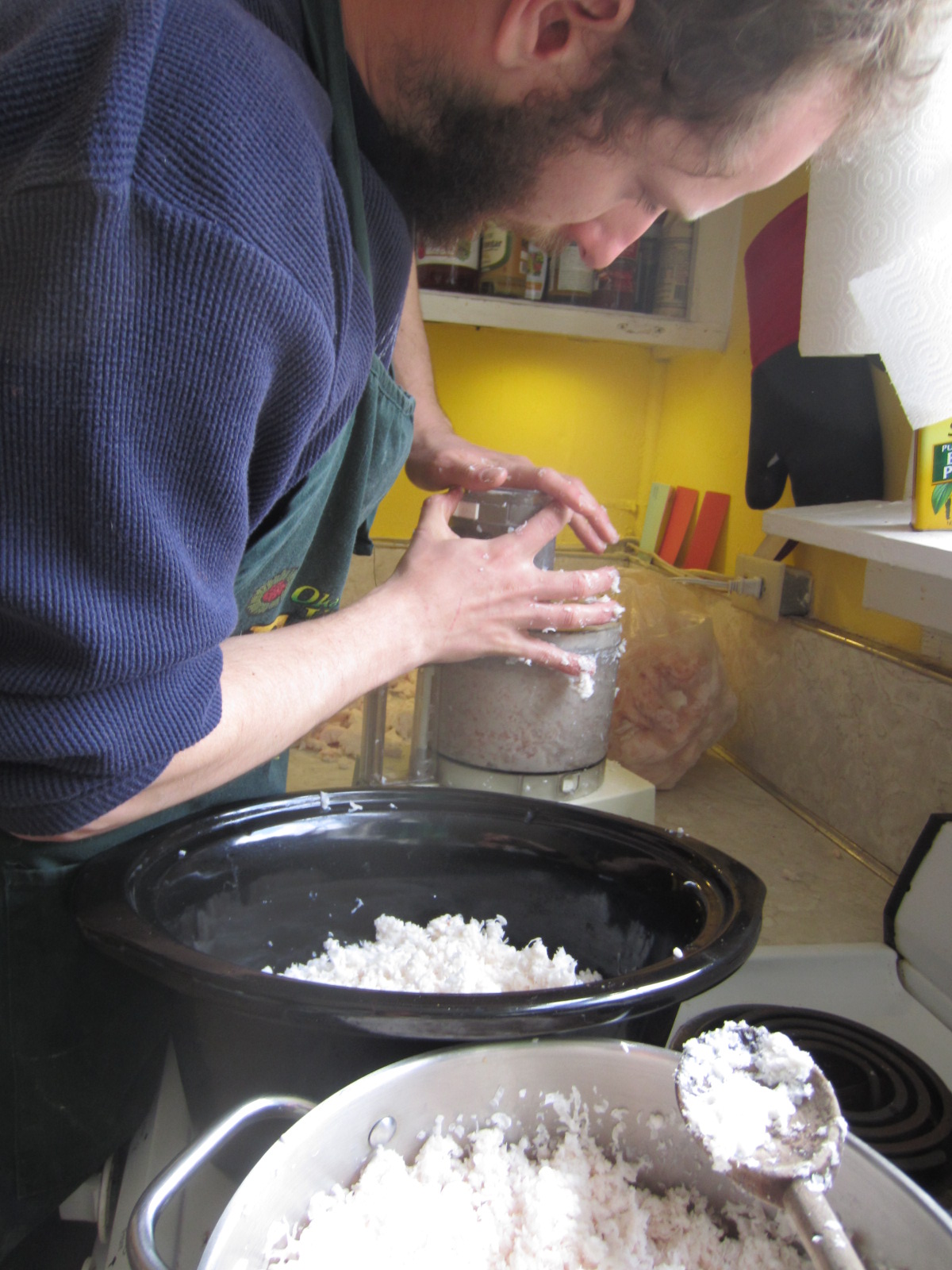
Rendering is the process of turning the chunks of fat that you’d find on the end of your porkchop into the buttery, smooth, shortening that you’d cut into your pie crust. We do it by grating chunks of frozen lard in the food processor and then putting the resulting shavings in the crockpot or in a pot on the stove over low heat.

Sean is grating the lard and rendering it in the two pots.

Sean is grating the lard and rendering it in the two pots.

The lard has to be very frozen to grate well. While dismantling the lardberg, we had to refreeze the chunks to get them to run smoothly through the grater. If you process enough lard this way, you’ll notice a buildup of white goo on the grater that resembles nothing so much as twinkie filling. The melting takes a while, but you don’t need to stir or monitor the pots. Most of the lard will turn to liquid and you’ll be left with floating, gray debris. At this point, strain the lard and set it aside.

yummmmm... If you have chickens, they'll love the fried McHeartattack Glop left in the strainer.

yummmmm… If you have chickens, they’ll love the fried McHeartattack Glop left in the strainer.

You can use it immediately if you’re making soap, or store it for later use in the fridge or freezer. It’ll solidify when it’s cool, but ours is liquid at what we call room temperature in Arkansas.

Mixing up the soap

You will need:

  • a couple of hours, most of which is wait-time
  • lard
  • lye
  • water
  • essential oils, herbs, whatever stuff you want to put in your soap
  • an accurate kitchen scale
  • kitchen supplies that you’re willing to sacrifice to soapmaking: a jar for mixing lye and water, something to measure lye into, a pot to mix the soap in, and a spoon to stir the lye and water mixture
  • something to use for a mold: a cardboard box lined with a plastic grocery bag works just fine
  • vinegar. SAFETY TIP: While mixing, know where your vinegar is, and have plenty. Vinegar will neutralize the lye if there’s an accident. Sean and I have made soap twice without a problem, but it’s better to be safe than sorry.

We’ve used the process and recipe described in this article from Mother Earth News. You weigh your lard, then calculate and double check how much lye and water to use. Add the lye to the water (NOT the water to the lye – this could splash lye around, which is dangerous) and let it heat up by the magic of chemistry and then cool to room temperature/slightly warm. This takes about an hour and it will get HOT, so make sure that you mix the lye and water in a place that you can count on to remain safely undisturbed for an extended period of time.

Measure carefully, then pour the lye into the water.

Measure carefully, then pour the lye into the water.

Carefully add the cooled water-lye mixture to the warm (95 degrees if you have a thermometer, warm when you touch the pot if you don’t) lard, plus any essential oils or goodies that you’d like to throw in there. We have used lavender oil and flowers to great effect, and we’ve just guessed at the amounts. Stir stir stir until the soap reaches the trace stage. This takes FOREVER. If it is at the trace stage, a drizzle of soap stays on top of the mixture. At this point, it’s ready to be poured into the mold. Don’t do it before it reaches trace: we made that mistake and had quite themess to contend with.

Shaping

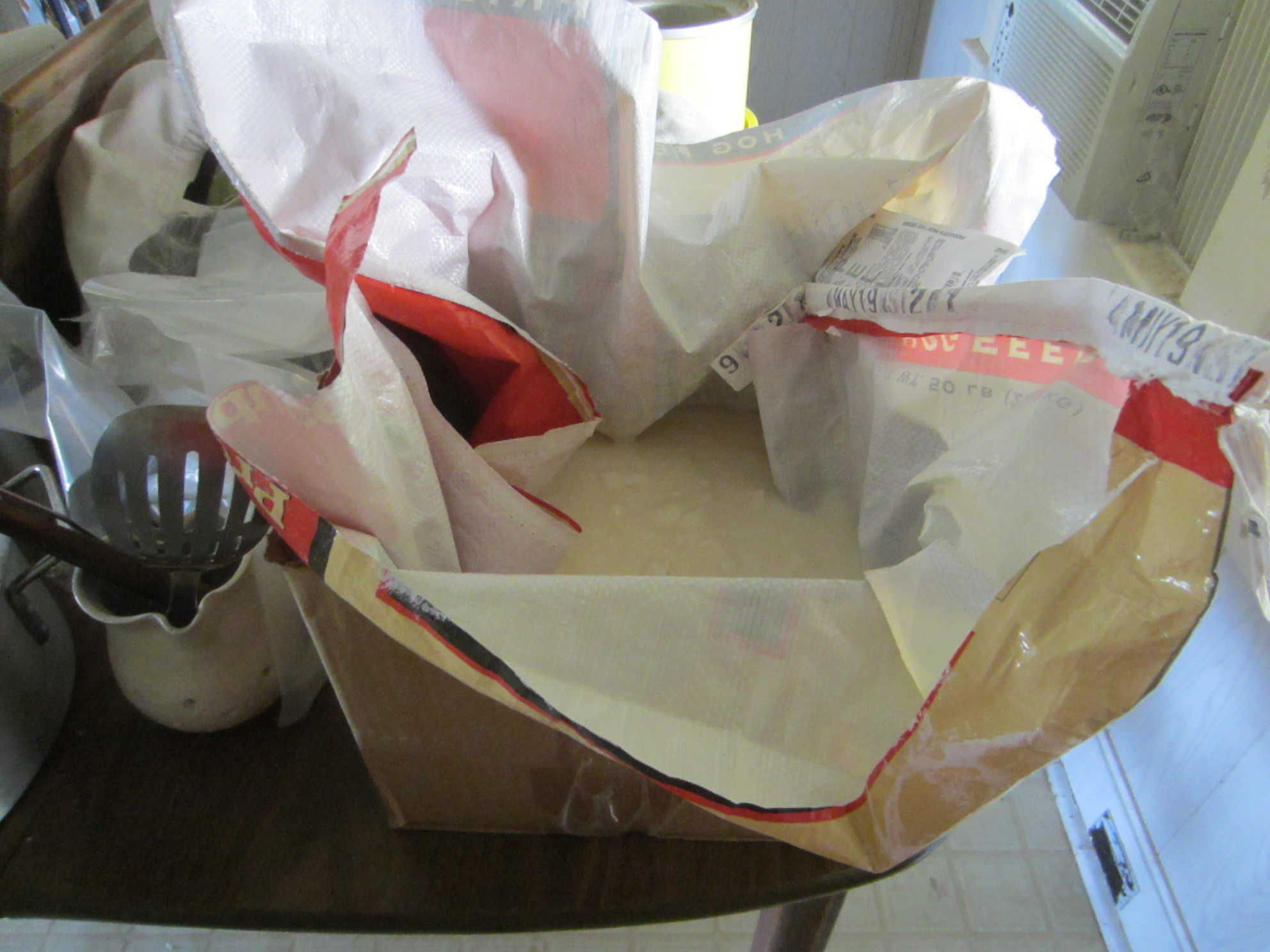
When we have made soap in the past, we’ve lined cardboard boxes with plastic bags, poured and scooped the soap in, then let it sit overnight. By morning, it had stiffened up enough to cut.

behold my cunning use of a feed back as a box liner!

behold my cunning use of a feed back as a box liner!

The first time, it was still soft and we were able to cut it with dental floss. The second time, we let it sit too long and it was harder and more brittle. We had to cut it with a knife, and the bars cracked and split. We’ve only made rectangular bars, but I think I’d like to try different shapes this time if I can find appropriate objects to use for molds. I might cut the top and bottom off of a plastic bottle and try to make some round bars this time, or use a pringles can.

Cleanup

Carefully rinse anything that had lye in it with vinegar, then wash it normally. Some sources recommended that you label your soap making supplies and use them only for soap making. I leave the mess in the pot that the soap was mixed in, set it aside in a dark and ignorable corner, and wash it out when the soap is declared cured a few weeks later.

Curing

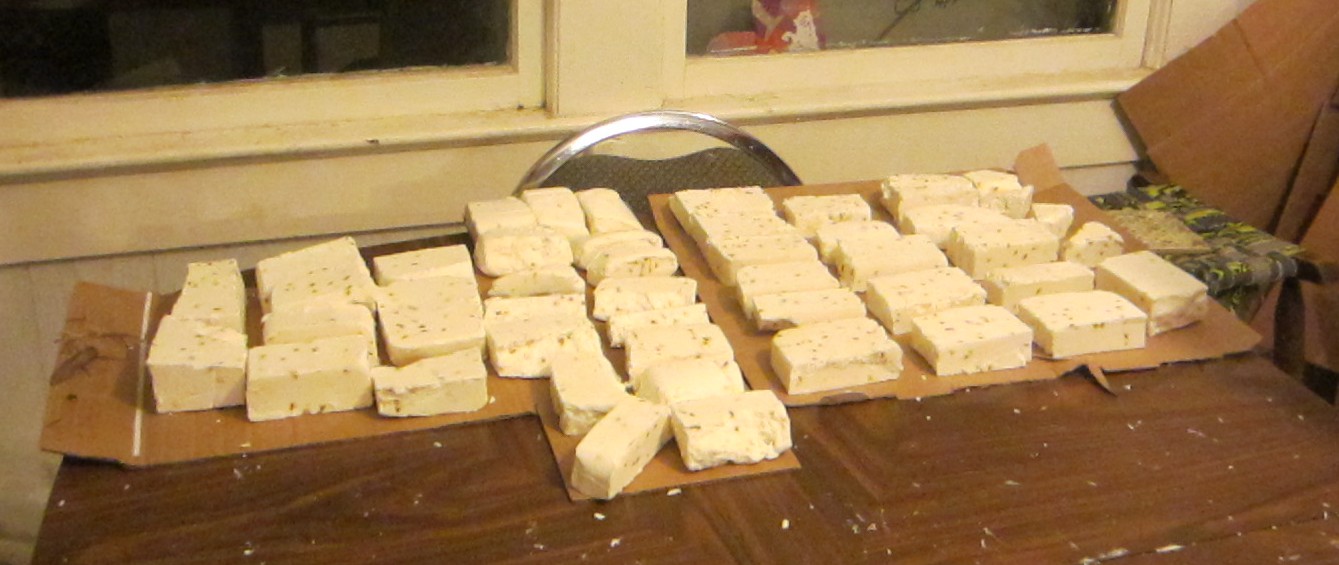
Lye soap must cure for at least two weeks before use, or it can burn the user. Some sources recommend waiting longer. I have laid out cardboard on the floor of the spare room or the dining table and spread the bars evenly on that, flipping them from time to time during curing. We haven’t had any hiccups in the curing part of the process: I think it’s pretty foolproof as long as you have some airflow and keep the soap away from children and pets (our cats were fine, but unlike dogs or children, they are very discerning about what they eat).

Curing

Curing! Our soap has lavender flowers in it: that’s the speckles.

The Product

The soap we make lathers wonderfully. The bars are hard, but the soap is smooth and creamy. I use it to make liquid hand soap (meaning I grate my bar soap and add warm water, then stick it in a dispenser) and dish soap, and when the huge container of laundry detergent I bought a year ago runs out, homemade laundry soap will replace that too.

If you’re planning to make your own soap, good luck! I can’t emphasize enough how rewarding it is to have all of our household soap coming from our land, animals and kitchen.

Garlic, Corn, Cukes and a Poem

Bonus Points: I also froze a couple quarts of stock today. Stock is not photogenic.

Bonus Points: I also froze a couple quarts of stock today. Stock is not photogenic.

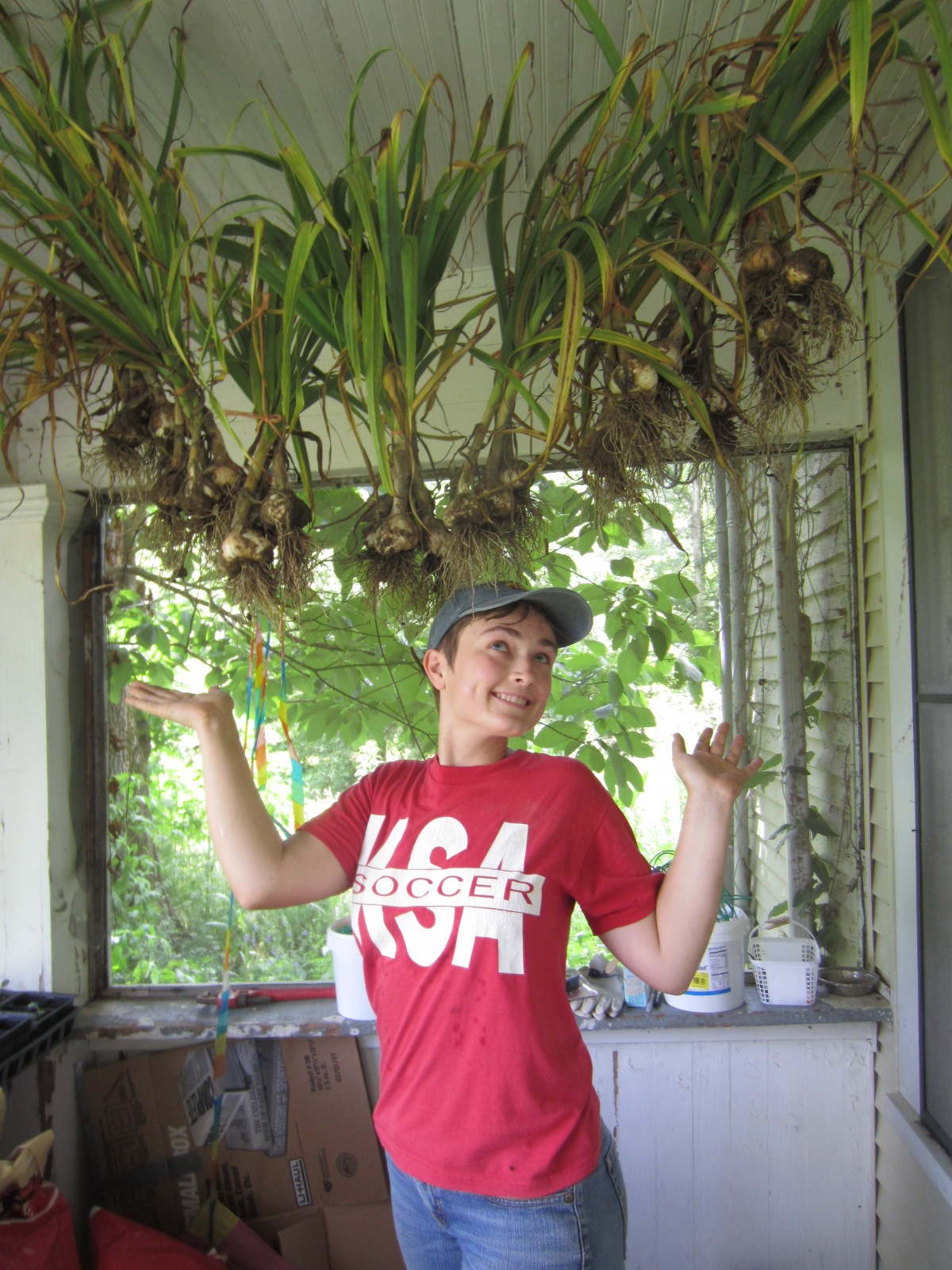
Today, I confirmed what I had long suspected: Arkansas is no place for garlic. We may be the only people in Lee County who grow it, which should have tipped us off. Several weeks back, we hung thirty heads or more to dry on the porch. It’s the only dark place with any air circulation that we could think of. Ideally, you hang your garlic someplace cool, dark and dry with plenty of air circulation, but we had to settle for just dark. Cool and dry don’t exist here in the summer. When I cut one head off of a bundle recently, about half of it smelled horrible and the skins had gone to brown slime. Most of the garlic inside was fine after a few rinses, but it was worrying. We were off on vacation a day or two after that, so I put it out of my mind.

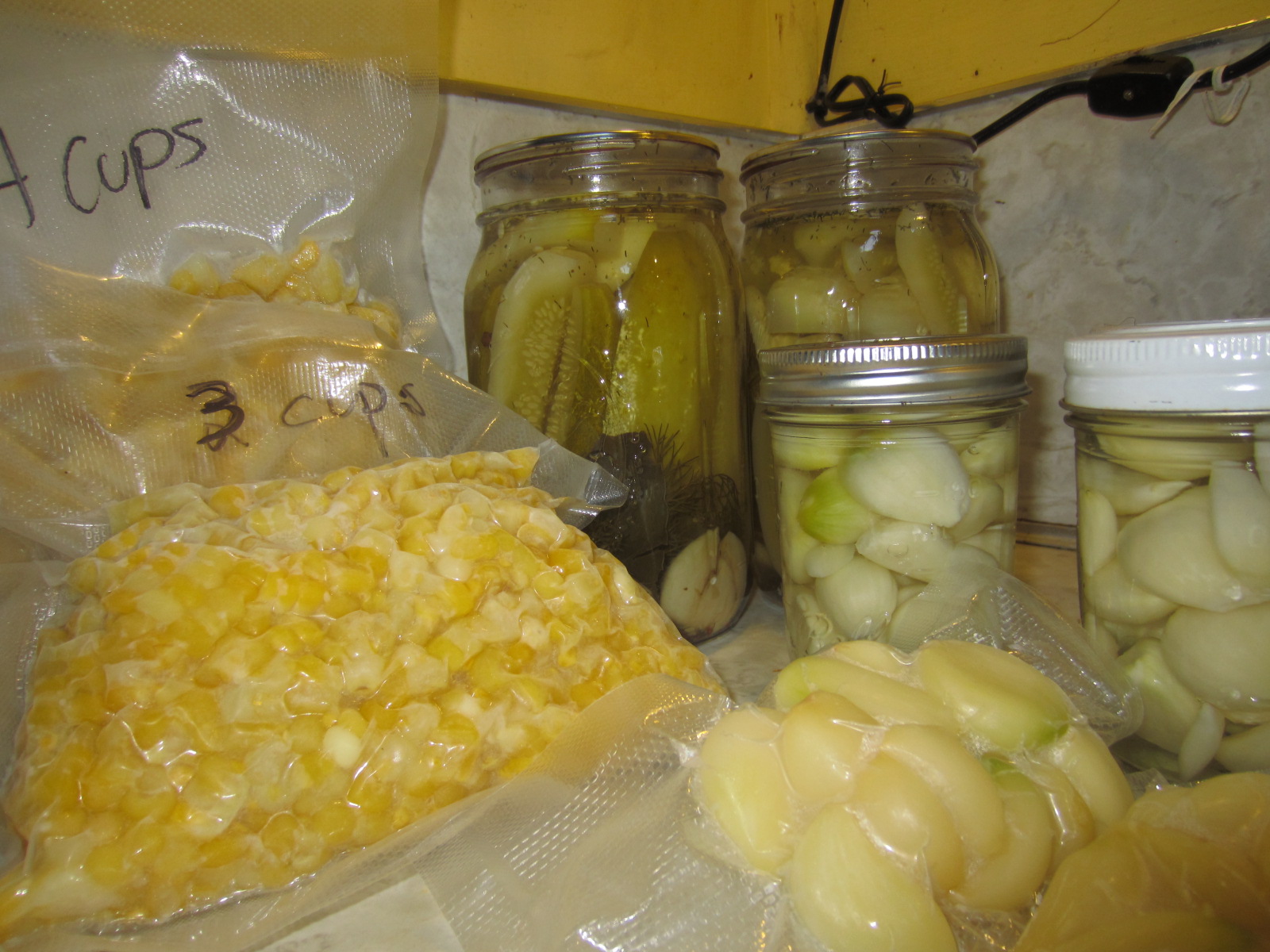
After summer school today, I cut down three more heads and they were all as bad as that first one. I asked the oracle (internet) and it yielded a bounty of suggestions. We’ve decided to try a few different methods for putting up our garlic just to see what works for us.

  1. We packed half-pint jars and poured boiling vinegar over raw heads of garlic. These should keep for several months (one source said a year) in the refrigerator.
  2. We packed more half-pint jars and poured cold vinegar over raw heads of garlic. These should keep for slightly less time in the refrigerator, so we’ll eat them first.
  3. I vacuum-packed and froze the remaining garlic.

Word on the street is that frozen garlic tastes right but loses its texture. Garlic packed in vinegar is supposed to taste close to fresh garlic. We’ll see.

In addition to garlic, we’ve recently found ourselves swamped with cucumbers and corn.

The cukes seemed to fly out of our garden like missiles for a week or so there. We’ve already eaten some of the quick-pickles that Sean whipped up and stuck in the fridge before we went to NC and they are wonderfully crunchy. That crunch is something you just can’t get with canned pickles. I wish we’d made more. We canned seven quarts of dill pickles already, and if the cukes keep up the good work, we’ll put up plenty more before we’re done.

The corn came from a friend. M invited us over to pick some of her sweet corn a few nights ago and we couldn’t resist. We nearly filled the trunk! Her husband put in more than an acre and it’s just for their personal use and for giving away. I have never tasted sweet corn so sweet. We couldn’t resist biting into it in the field, and that first syrupy crunch gave us enough of a rush to keep us picking until we were fixin’ to drop. Pulling the ears from the stalks made a satisfying crunch, and it left my hands sticky and my neck itchy from where the tall leaves had brushed my skin. We shucked and blanched the corn on the cob, then cut it off into a bowl. I tried to vacuum seal several bags of it but the corn was too juicy! The machine couldn’t seal the bags because the vacuum would pull all the liquid up to the edge. I have been freezing the corn on trays prior to vacuum-sealing, which is working well. Putting it up is a lot of work and we bit off more than we could chew, so we gave away bags of the stuff today to the women we work with at school.

IMG_2722

Sunrise Run Poem

I saw a buck in velvet
still in the green puddle of his shadow
that shattered on the gravel

I never saw him move
only saw him hanging over a field of sorghum
like the moon hangs in the sky

Allergies to bees, lead and sweat

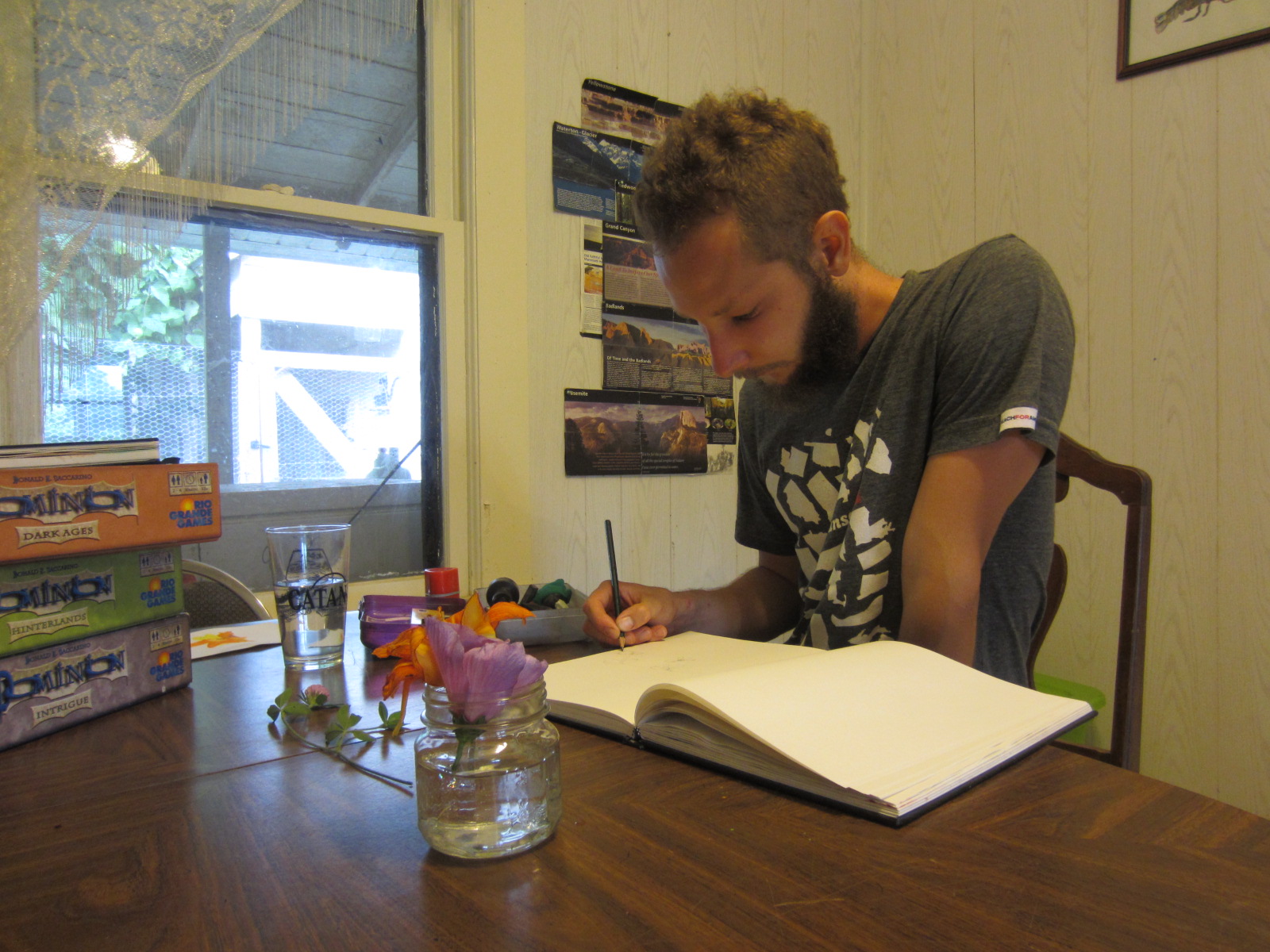
Sean has been in a creative mood all week. He’s done some drawing and painting, but, most wonderfully, he leaped up last night and declared “I’m feeling inspired!”
“Inspired how?” I inquired of the grinning fellow, posing like a superhero before me.
“Inspired to cook!” He proclaimed, and sprang to work in the kitchen. These are the best days.

IMG_2577

Practical projects make my heart flutter. Anything that simplifies or brightens daily tasks is worthwhile to me. My superhero name is The Obviator. Though it doesn’t really improve the functionality, refurbishing this coffee table was my great accomplishment of the week:

IMG_2465

Materials:

  • Crappy old coffee table
  • Unwanted maps
  • Paint
  • Paint brush
  • Elmer’s Glue
  • Polyurethane to seal the top

Paint the coffee table, water down the glue a tiny bit, affix the maps making sure to minimize air bubbles, add a few coats of watered down glue to the top, allow to dry, seal with polyurethane. Don’t let your cats jump up there during any of the drying phases.

IMG_2537 IMG_2566

On Wednesday, we totally pigged out on nori rolls and watched Frozen with Ian. We talked big talk that day about key lime pie and key lime pie ice cream. Since Freckles is our only layer right now, we’ve had to wait a while to accumulate the necessary eggs for these projects. I made the pie a few days ago, and we’ve had to employ great self-control to keep from finishing it off before it can be added to the ice cream (which takes four eggs). Thank goodness we picked up some pullets this week. We are not getting enough eggs.

We were chasing the pullets out of their sequestration in the henhouse one evening (Cappy and Freckles wouldn’t let them out) when a wasp stung Sean right in the nose. His cheeks and top lip swelled up so much that he looked like Hermione’d jinxed him to hide his identity from Snatchers. We drove down to the neighbors’ and Nancy took one look at Sean and sent us on to the doctor. The folks at the doctor’s office giggled over the comparison between his swollen visage and the photo on his license, gave him a steroid shot in the butt and a prescription for an epi-pen and sent us on our way. Sean wore sunglasses in public for a day and a half like a starlet trying to fool the paparazzi.

Yesterday, our neighbors took us for a ride in their party barge on Moon Lake. While we were floating on foam noodles in the muddy oxbow lake, succumbing to our first sunburns of the year and talking about allergies (Sean was still looking vaguely rodentine), Nancy told us the story of her grandfather’s death.

The year was 1921 and my grandfather had just acquired a divorce, a rare thing in those days. He was a bit of a lady’s man, and he’d been fooling around with the secretary in his office at the county courthouse. She was under the impression that he planned to marry her, though he had no such intentions. When she realized that he wasn’t serious, she came to work with a gun to shoot him right there in the courthouse. He didn’t want to get shot, so he tried to take the gun away from her. While they were struggling, her daddy came in, and, remembering that my grandfather kept a gun in the desk drawer, reached in, took out that gun and shot him in the gut. Shot her, too, on accident, but didn’t hurt her. My grandfather, it turns out, was allergic to lead. He died a week later.

In other news, we’re getting ready to teach summer school at Lee. I’ll be teaching Algebra 1 to two groups of kids each day in 90 minute blocks. I’m so excited! I’ve always wanted to teach 90 minute blocks, and I love teaching Algebra. Bonus points: the money is really good and we’re working only until about 12:30, so we still get to work in the garden and get outside in the afternoons. I’m going to try something new where I don’t have rules exactly, but instead I have a poster that reads something like this (shoulda taken a picture: whoops)

In this classroom you will…

Challenge Yourself

Respect, Honor and Support Everyone

Follow Directions

Ask Why

Learn from your mistakes

Act like and be treated like a young adult

I like it because it sets positive expectations for the kids and for me. These are better than rules: These are facts. You will do these things. I can give both positive and negative consequences based on these statements. I’m really super-stoked.

Canoeing Montage!

IMG_2501 IMG_2506 IMG_2513 IMG_2527

As for me, I’m not really allergic to anything, but working out(side) in Arkansas in the summer makes me sweat, and sweat makes me itch and go all bumpy from eczema and before you know it I’m a mess. It’s a great excuse to come in and take frequent, cool showers.

Got any summer plans? No. But I’ve got a canoe.

Summer’s here and time is measured in drops of sweat and changes of damp clothes. Last night, the heat woke me from a sound sleep for the second time. It’s stifling when you can’t open the windows for fear of the blackflies.

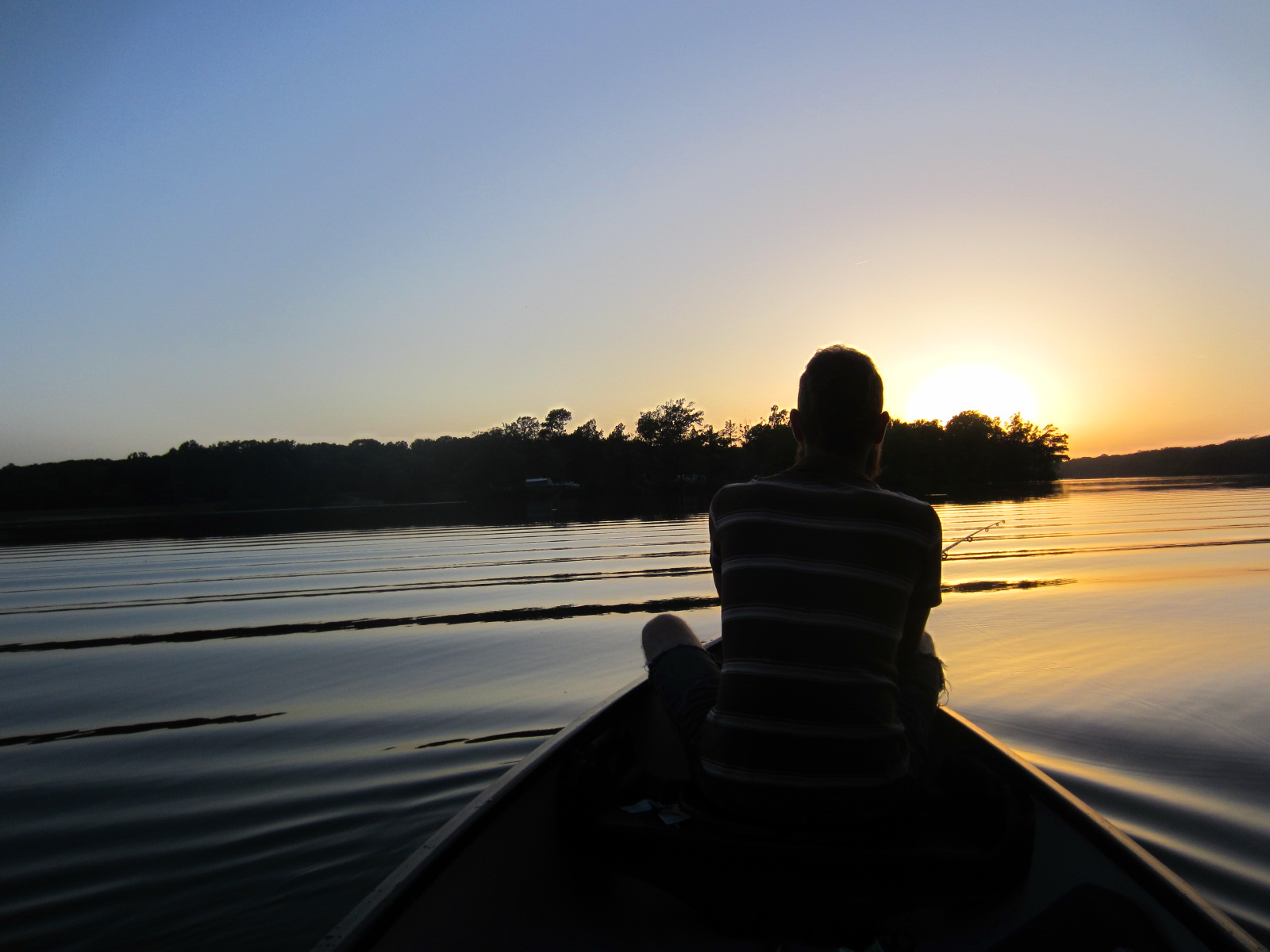
It’s cool and bug free on the lake. and the moon has been enormous and golden, floating like a reflection in the sky full of glittering water beetle stars. In the evenings, we’ve seen the sun set twice over the water and it’s filled a part of me that I didn’t know was drained. We’ve explored some of the coves and creeks nearest to the boat dock by day; we’ve seen herons, turtles and a snake that slipped through the water silently. We’ve managed to cram four people into the canoe and not flip it, and to mostly avoid sunburn. I don’t have summer plans, but I do have a canoe, and I could pull a Huckleberry Finn from here.

IMG_2460

It’s only fifteen minutes from sitting on the couch to floating on the lake. Bonus points: the canoe has a built-in cooler.

A neighbor is delivering a round bale of old hay sometime this week and we’ll use that to mulch the garden. It’ll be a tremendous help for keeping the garden moist and minimizing hose-dragging. We had a soaking six inches of rain last week, but the summers here are not wet, and dragging a hose around in the heat is a torture I’d prefer to reserve for my enemies only, when possible.  We’ve managed to clear the weeds around the cucumbers (we’re getting several every day now) and in some of the aisles, but we have a long battle ahead of us. Little green tomatoes and winter squash are appearing on the vines, and we’re looking forward to blackberries in a few days. Cabbages and some garlic came in today, and carrots and turnips yesterday. We’re moving into the hot months where nothing new is planted and we just weed and harvest and try to keep the bugs and coons from eating everything we grow.

Image

We brought in our first batch of garlic today. Drying isn’t really a thing here, but we’re hoping for the best.

Image

I was taught to not pick up hitchhikers, but his pack looked so heavy and he seemed harmless. I gave him a ride from my cabbages all the way to the woods.

We’re heading up to Forrest City to watch a World Cup game at the Mexican restaurant this evening. If we’re lucky, we’ll pick up a few pullets in Wynne to keep poor Freckles company. In other livestock acquisition news, Sean is seriously scheming to buy a feeder pig and drag it to North Carolina for a luau in a few weeks. His Granny is turning 90 and we’re going to help celebrate. My partner is seriously nuts. Who does that?!