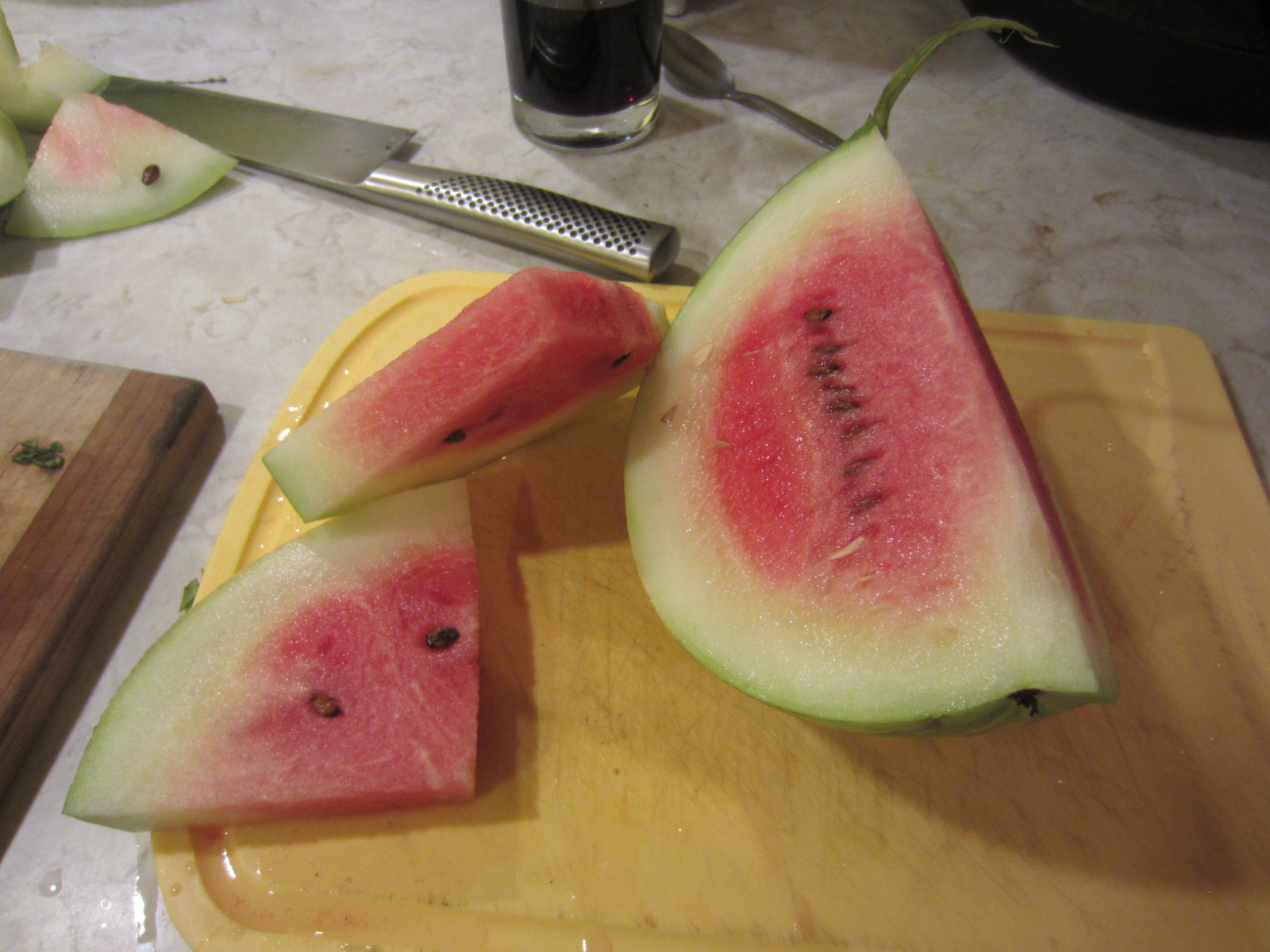
Our first (pink) watermelon. It’s hard to know when they’re ready, and melons left in the garden too long invariably get devoured by the hungry Chunky family.
5:50 a.m. I try to wake up and start my run before I realize what I’m doing. Sean stays in bed, letting the sun pink the walls slowly as he eases into the day. Usually by the time I wake up fully, the sun is just breaking over the trees and I’m smiling, halfway down the road. I try to push my distance a little every day, to run the length of that sorghum field, to circle that pole barn, to turn around at that road cut. This morning, I startled a young possum in the ditch and was myself startled by a rattlesnake, as big around as my bicep, curled dead in the road.
I come home, shower, and get dressed in my teacher uniform: usually a skirt, a t-shirt, flats, and earrings. Sean packs my laptop, a waterbottle and a banana in my bag and pops in a bagel for me. At 7:00, we’re out the door.
7:45 a.m. Papers laid out, pencils sharpened, we’re in the cafeteria, watching the kids eat breakfast, breathless from the whirlwind of copying and tidying before class. At 8:00 we walk our groups to our respective classrooms, and teach for two 90 minute blocks with a thirty minute recess in the middle where we supervise the kids on the patio. The first few minutes of class is always a push to get kids settled and working on their do now/bellwork/entry task. The bells don’t ring during summer school, so there’s no distinct start to class, and kids take advantage of that blurred line. Someone is usually singing or building a paper airplane or pretending they can’t find a pencil or paper (I provide them: they’re right in front of you, dingbat), or squabbling about a seat. After bellwork, we get rolling with a discussion or experiment and I get them going on a problem or a problem set within ten minutes. At Lee, I’ve found I can count on about a three-minute class-wide attention span. I’ve got ten at Palestine, but I have more relationships, authority, and reputation up there. I break up the work-time accordingly, so we review problems frequently and I give plenty of opportunities for kids to talk math. It looks like mayhem, but it works pretty well. I did a bangup job of captaining my team to victory over function notation today. The most fabulous disruption of the day was this:
I’m assisting a student on one side of the classroom.
A student asks permission and then gets up to sharpen his pencil.
There’s a commotion on the other side of the classroom from me, near the pencil sharpener.
K: Whoah! he’s getting sexual over here!
R: did you see – he – he – he tried to kiss me!
J: (from across the room) BWAKAHAHAHAHA — HE’S GETTING SEXUAL!
I glare at J and she turns down the volume
M: I didn’t try to kiss him! I was just making kissy noises! (Makes kissy noises)
J: (from across the room) OMG (Makes unreasonably loud kissy noises)
R: He tried to kiss my EAR!
12:00 It’s hot at noon in Marianna. It’s really, really hot. I get headaches and I sweat like pigs would sweat if they could (they can’t). We wait outside on a covered walkway for the buses to come after lunch, and keep kids from hurting each other or sneaking away to do who-knows-what behind the building. It’s a steam-mirage of sneakers smacking the concrete, yellow buses, sticky blacktop, yelling voices, sweat. At 12:30 we get to leave, and it’s a horrible relief to sink into the soft passenger’s seat of the Nissan: a relief because I’ve been on my feet for six hours already, horrible because our car is black and the inside at noon is hot enough to explode cans of soda (true) and melt rubber bands (true). Sean starts the car and we crank the A/C. It roars and sputters and blows hot air like a salon for the first few minutes, then blessed cold. By the time we’re halfway home, we can turn it down to half-power.
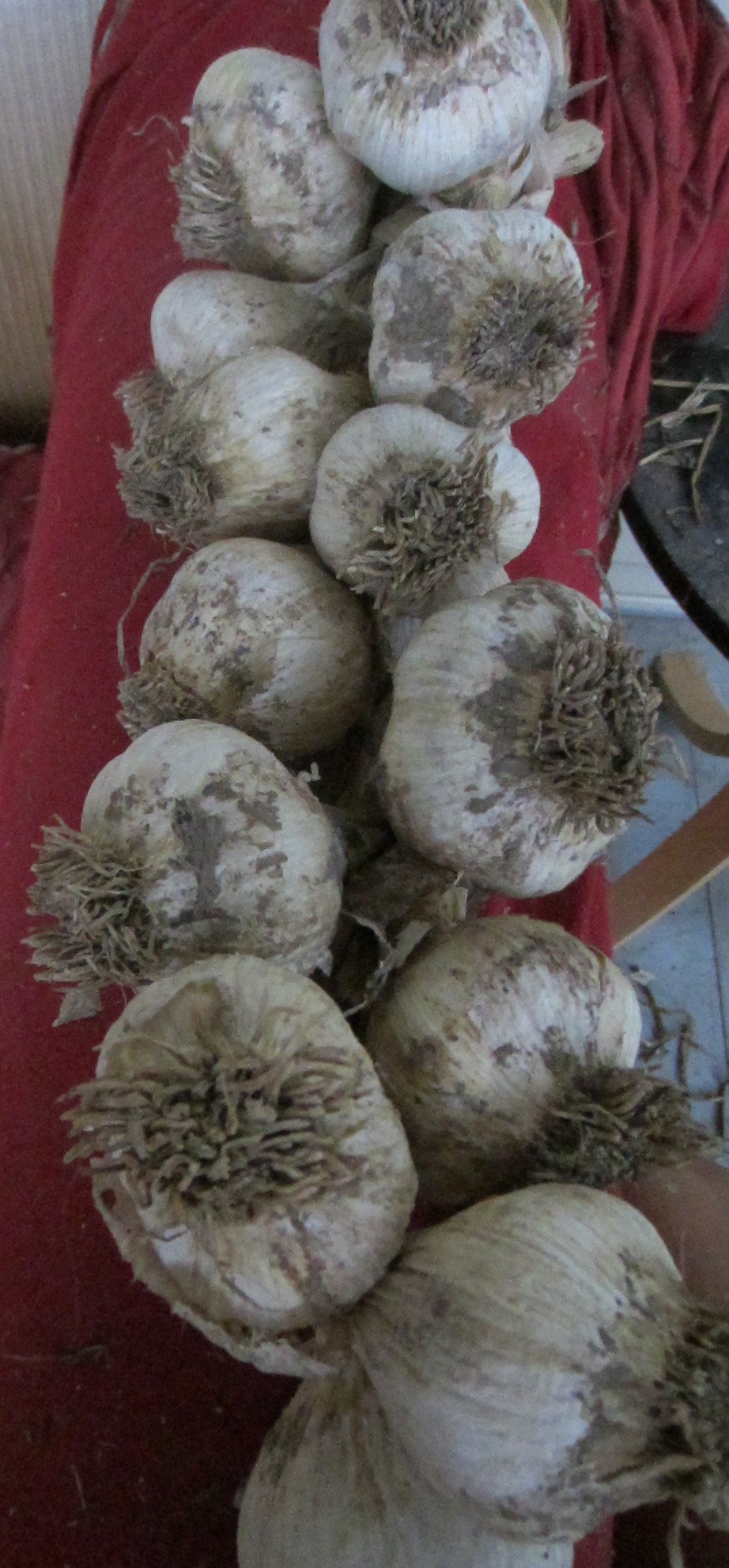
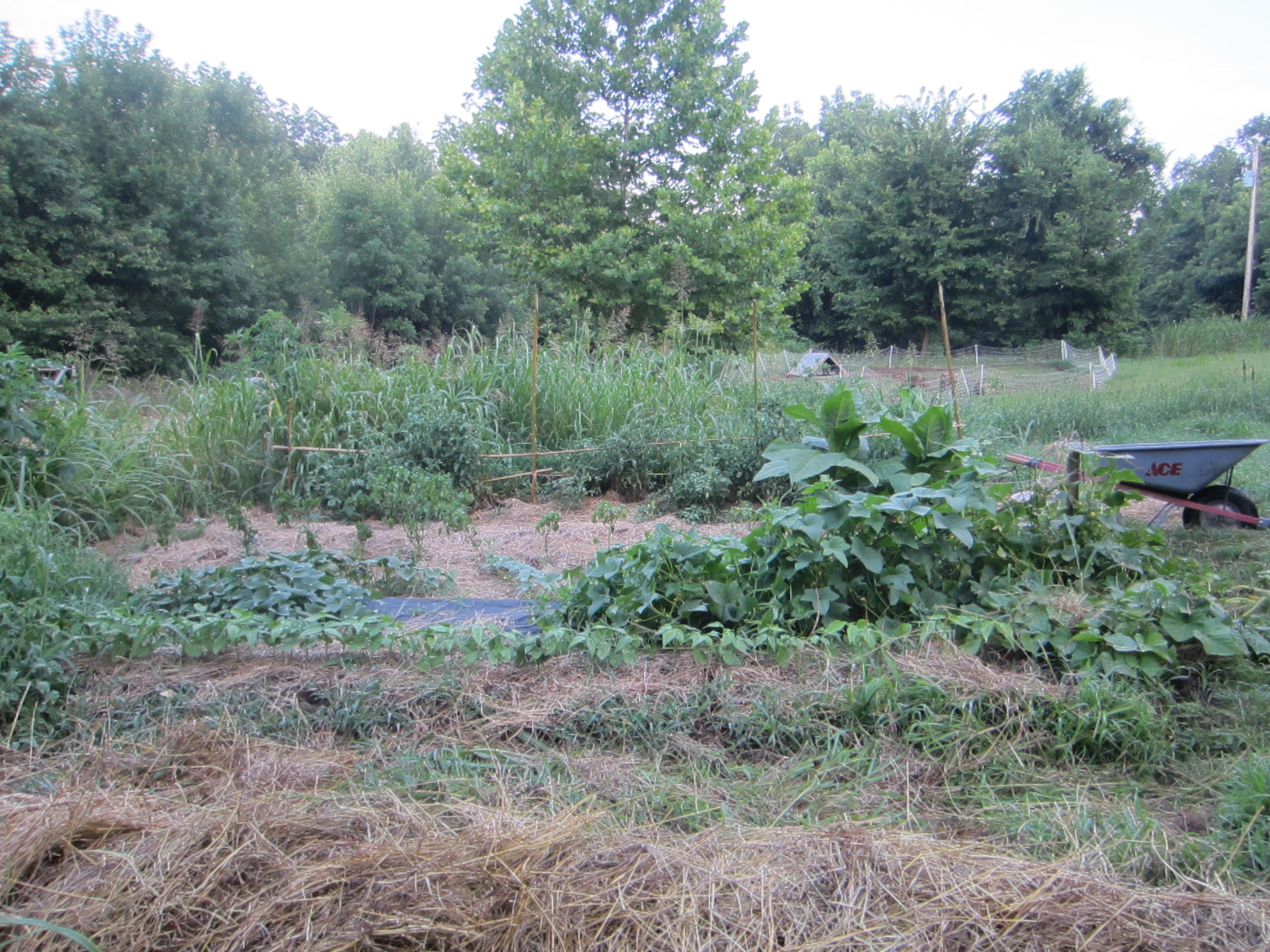
1:00 p.m. It’s too hot to work outside. Sean fixes us lunch and I spend a few hours in the afternoon each day working on indoor projects: canning, tanning, lesson planning. I do some dishes, dick around on the internet, read a little, tidy something somewhere, check on the chickens, and suddenly it’s sunset, and well past time to think about dinner. Sometimes, we manage to work in the garden for a while, but lately it has not cooled off until just before dawn, and gardening in the afternoon in these conditions is out of the question.
8:30 p.m. Dinner is usually something wonderful: we rarely visit the store these days, so our meals are almost all Arkansas-grown. Tonight, it’s braised cabbage with green apples and caramelized onions, our cherry and tarragon turkey sausage, and cucumber, basil and mint salad with slivers of red onion. Not from here: red onion, green apple. We eat on the futon under the clicking ceiling fan and watch a movie or an episode of something (Freaks and Geeks, tonight) with the volume up to drown out the window unit that growls in the background.
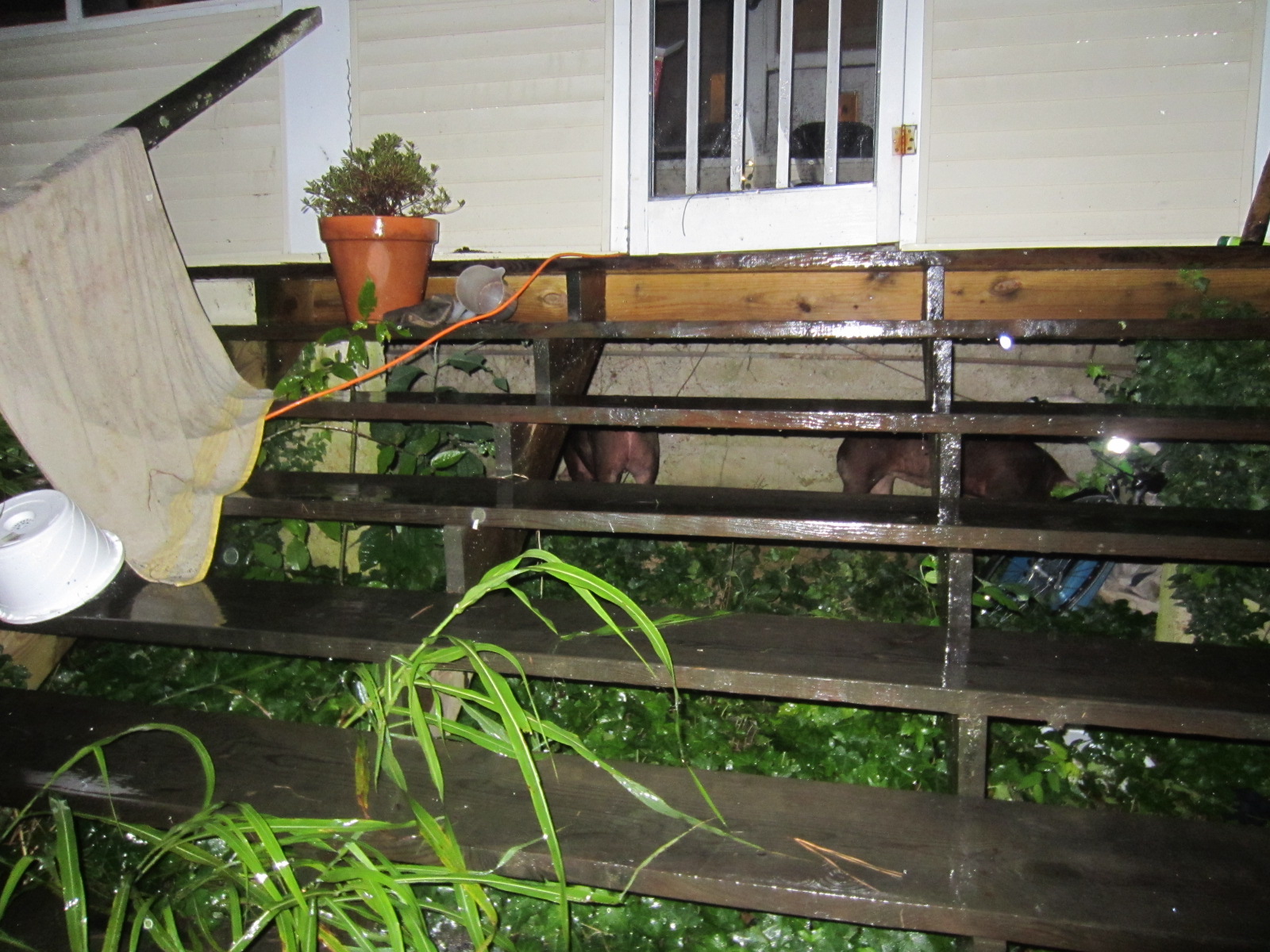
900 p.m. It’s storming and, inevitably, there’s a crisis. Sean goes down to check on the pigs and I hear him hollering over the thunder. I rush to the porch door and peer out through the curtain of rain, looking for the flashlight.
“are you there, Sean?”
a flicker of light through the six-foot tall jungle of wet grass
“yes but the pigs aren’t. I can’t find them anywhere.”
Sean slumps up to the steps, exhausted at the prospect of the wet, muddy search ahead, and I’m ready to head in and grab my coat when there’s an unmistakable grunt from under the porch, then a chorus of snurfles. The pigs are under the porch, sheltering from the storm.
10:00 p.m. late, cold dinner. Turns out, there’s not a damn thing you can do to move a 150 lb pig that doesn’t want to go out in the rain. Damn. They’ll be there in the morning, the impudent swine.
This week, thanks to the leisurely summer school schedule, I’ve tanned my coon hide, dug potatoes, cleaned out the fridge, put up garlic and corn, and rendered something like four gallons of lard. Today, I aim to get a batch of soap curing. Soap making is a process that, for us, starts with a half a hog laid out on the kitchen table.
Butchering
When we butchered our pigs, we just heaped the lard up in piles to deal with later and focused on the cuts of meat. At the end of the day, we threw the heaps of fat-chunks in grocery bags and stuffed them in the freezer. This was a poor choice because 1) it was a waste of the high quality lard that we should have saved for pastries and the like and 2) we wound up with 25 pound “lardbergs” to contend with when we finally got around to rendering. I spent hours yesterday trying to cut a greasy fat-glacier into chunks that would fit into the food processor! Next time, we’ll sort the lard by quality, then freeze the (strategically sized) chunks on sheet pans and bag them once they’re frozen.
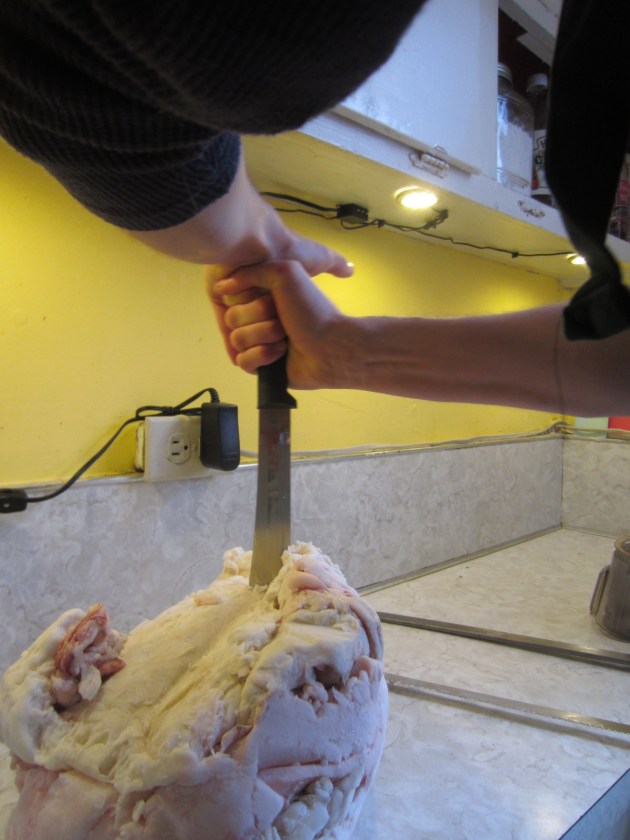
Meet Lardberg. The fat never really freezes solid, so it quickly becomes slippery at room temperature and attempts to slime its way onto the floor like a snail with a shell made of fat.
Rendering
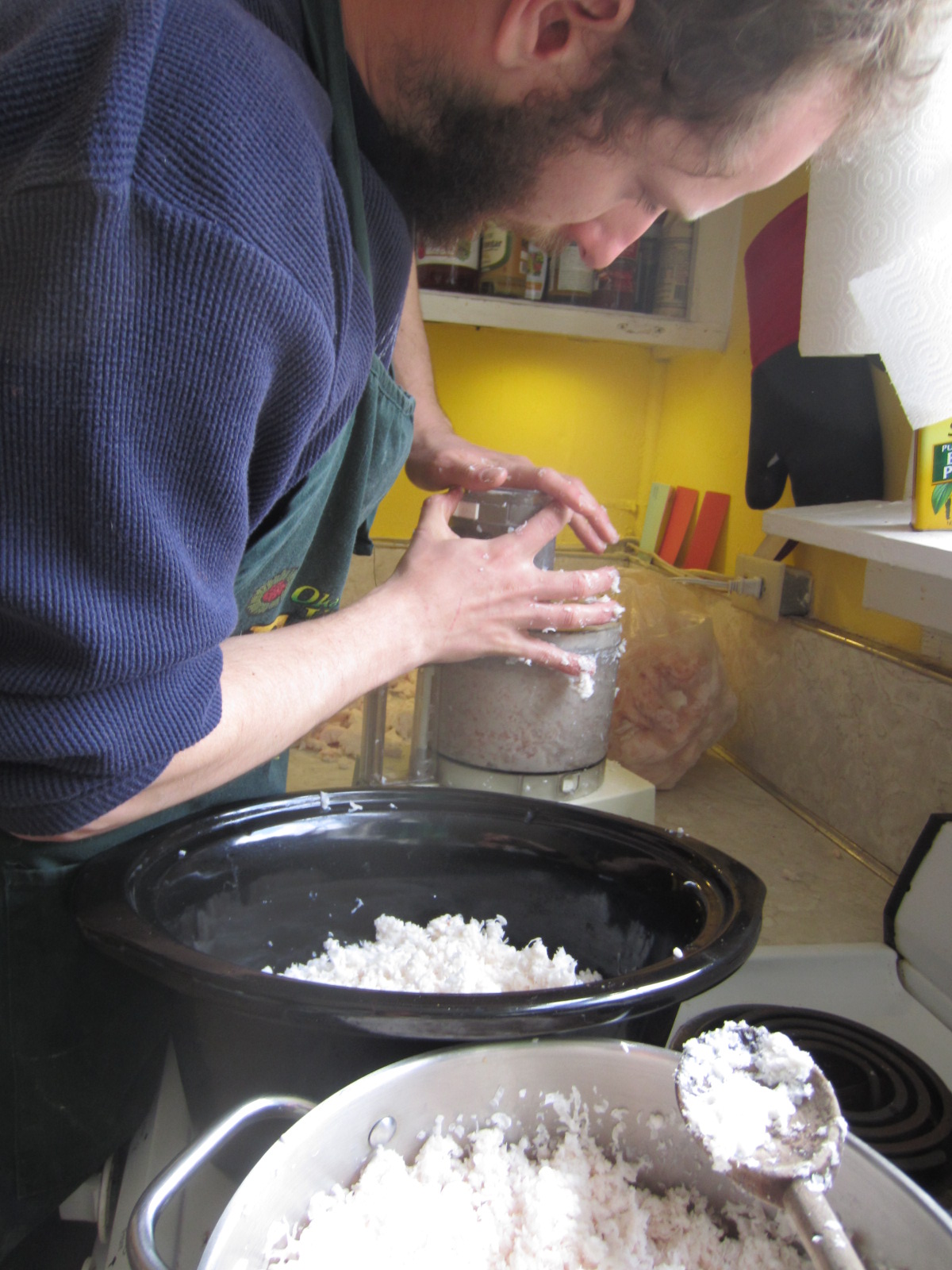
Rendering is the process of turning the chunks of fat that you’d find on the end of your porkchop into the buttery, smooth, shortening that you’d cut into your pie crust. We do it by grating chunks of frozen lard in the food processor and then putting the resulting shavings in the crockpot or in a pot on the stove over low heat.
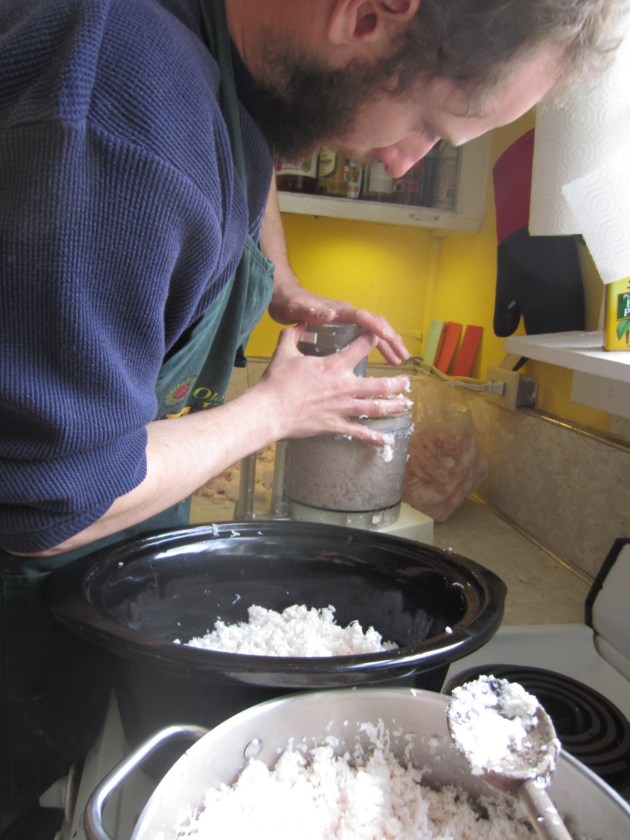
The lard has to be very frozen to grate well. While dismantling the lardberg, we had to refreeze the chunks to get them to run smoothly through the grater. If you process enough lard this way, you’ll notice a buildup of white goo on the grater that resembles nothing so much as twinkie filling. The melting takes a while, but you don’t need to stir or monitor the pots. Most of the lard will turn to liquid and you’ll be left with floating, gray debris. At this point, strain the lard and set it aside.
You can use it immediately if you’re making soap, or store it for later use in the fridge or freezer. It’ll solidify when it’s cool, but ours is liquid at what we call room temperature in Arkansas.
Mixing up the soap
You will need:
We’ve used the process and recipe described in this article from Mother Earth News. You weigh your lard, then calculate and double check how much lye and water to use. Add the lye to the water (NOT the water to the lye – this could splash lye around, which is dangerous) and let it heat up by the magic of chemistry and then cool to room temperature/slightly warm. This takes about an hour and it will get HOT, so make sure that you mix the lye and water in a place that you can count on to remain safely undisturbed for an extended period of time.
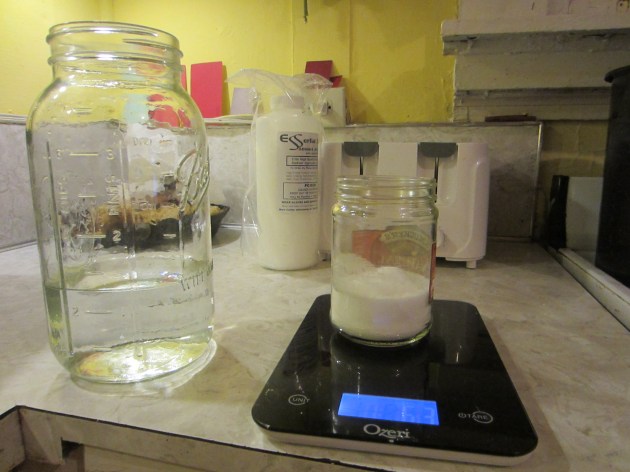
Carefully add the cooled water-lye mixture to the warm (95 degrees if you have a thermometer, warm when you touch the pot if you don’t) lard, plus any essential oils or goodies that you’d like to throw in there. We have used lavender oil and flowers to great effect, and we’ve just guessed at the amounts. Stir stir stir until the soap reaches the trace stage. This takes FOREVER. If it is at the trace stage, a drizzle of soap stays on top of the mixture. At this point, it’s ready to be poured into the mold. Don’t do it before it reaches trace: we made that mistake and had quite themess to contend with.
Shaping
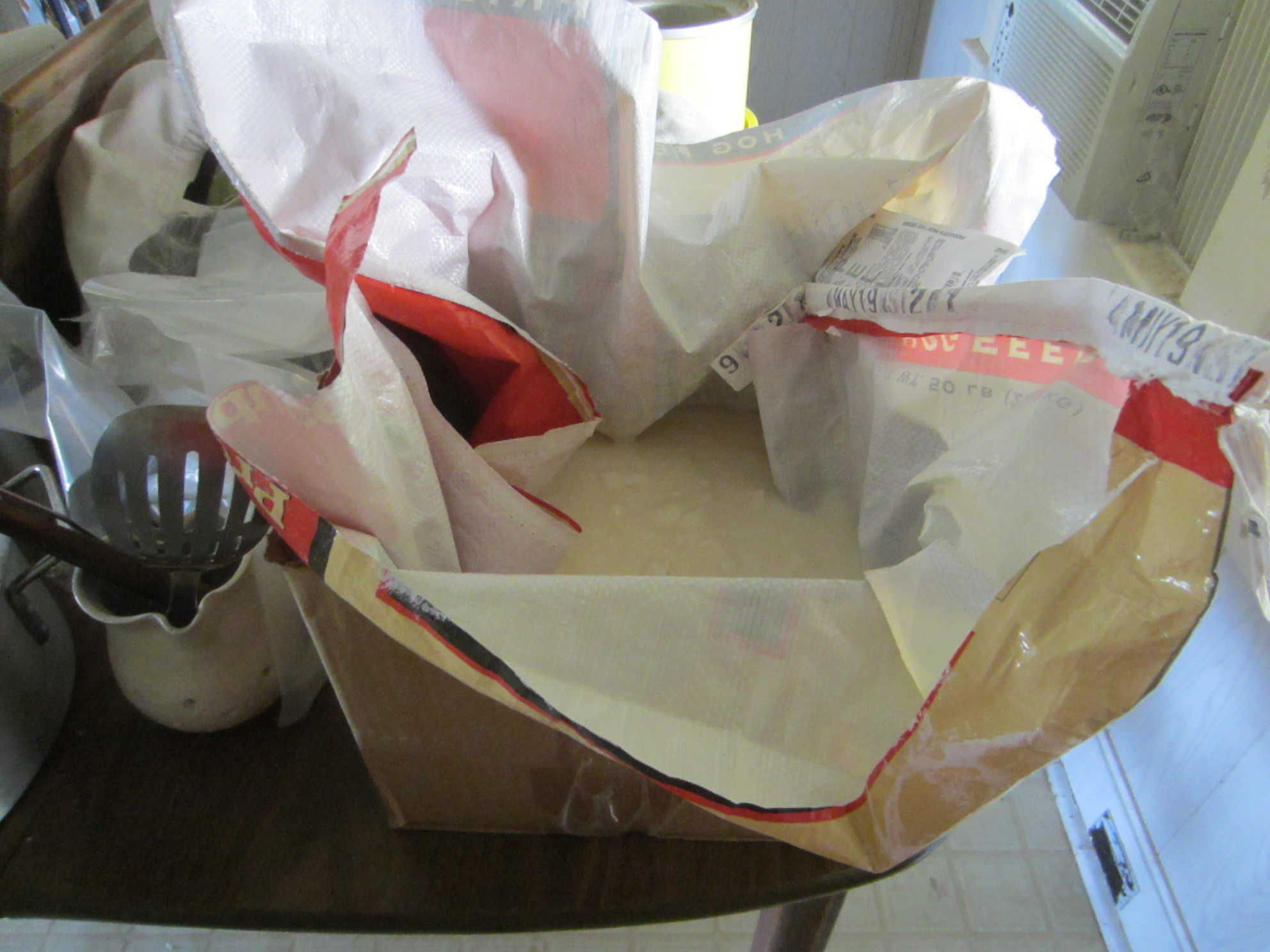
When we have made soap in the past, we’ve lined cardboard boxes with plastic bags, poured and scooped the soap in, then let it sit overnight. By morning, it had stiffened up enough to cut.
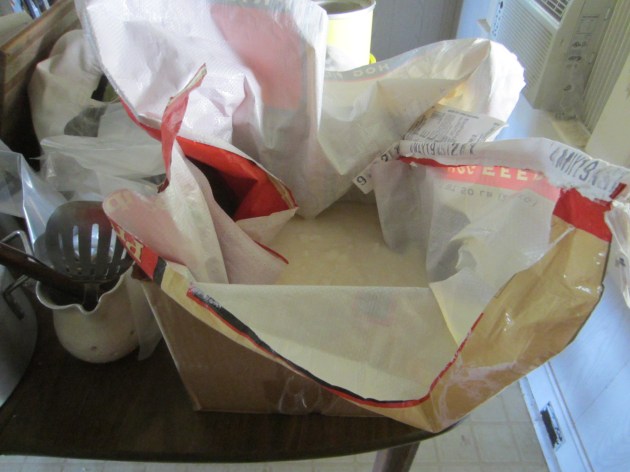
The first time, it was still soft and we were able to cut it with dental floss. The second time, we let it sit too long and it was harder and more brittle. We had to cut it with a knife, and the bars cracked and split. We’ve only made rectangular bars, but I think I’d like to try different shapes this time if I can find appropriate objects to use for molds. I might cut the top and bottom off of a plastic bottle and try to make some round bars this time, or use a pringles can.
Cleanup
Carefully rinse anything that had lye in it with vinegar, then wash it normally. Some sources recommended that you label your soap making supplies and use them only for soap making. I leave the mess in the pot that the soap was mixed in, set it aside in a dark and ignorable corner, and wash it out when the soap is declared cured a few weeks later.
Curing
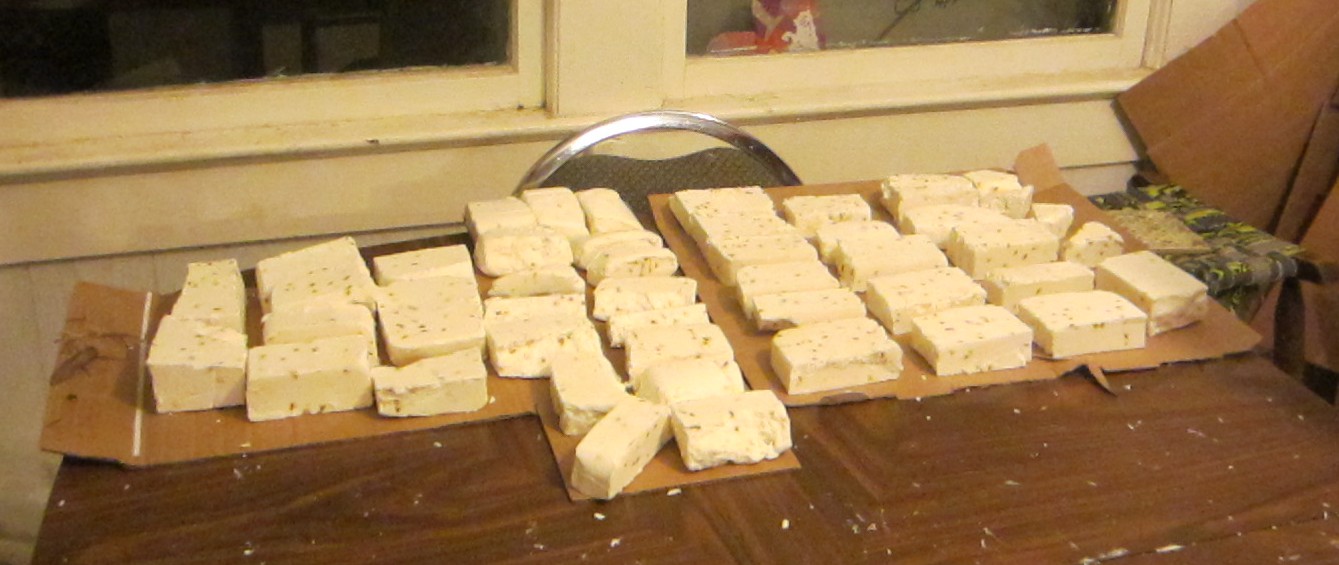
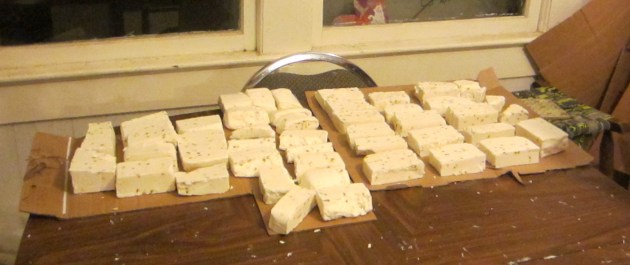
Lye soap must cure for at least two weeks before use, or it can burn the user. Some sources recommend waiting longer. I have laid out cardboard on the floor of the spare room or the dining table and spread the bars evenly on that, flipping them from time to time during curing. We haven’t had any hiccups in the curing part of the process: I think it’s pretty foolproof as long as you have some airflow and keep the soap away from children and pets (our cats were fine, but unlike dogs or children, they are very discerning about what they eat).
The Product
The soap we make lathers wonderfully. The bars are hard, but the soap is smooth and creamy. I use it to make liquid hand soap (meaning I grate my bar soap and add warm water, then stick it in a dispenser) and dish soap, and when the huge container of laundry detergent I bought a year ago runs out, homemade laundry soap will replace that too.
If you’re planning to make your own soap, good luck! I can’t emphasize enough how rewarding it is to have all of our household soap coming from our land, animals and kitchen.
I am wildly excited about summer school right now.
Background info: Summer school at Lee has turned out to be only fifteen teaching days, and I will teach only eleven of them. Today was my seventh. I am teaching ninety minute blocks twice a day primarily to groups of students who scored below proficient on their eighth grade benchmark assessment. Like most students whom I have taught, they struggle with basics of mathematics like adding and subtracting integers, multiplication facts, long division, operations with fractions and decimals, and reading for comprehension.
On Monday, I nearly lost my stuffing. My lessons had gone poorly, though I’d been on top of behavior, and I was still remediating the objective (order of operations – not even in the ninth grade curriculum) that I had scheduled for the first day of class and my attempt to give them a hands on activity to introduce variables had totally backfired. I’d been gone for four days, my students hadn’t completed the practice that I had left, and they were acting out, tired of doing the same type of problems over and over again. I was feeling frustrated, ineffective, and angry with myself. I felt exactly like someone who was being paid very, very well to knock down a well-built brick wall by hurling herself against it. I felt like an oppressor befuddled by passive resistance (Lee County’s students are students of Gandhi, not of mathematics).
On Tuesday, I kicked my rear into gear and taught a lesson on solving equations, which I love to teach. I tied it so thoroughly to the foundation we’d laid in order of operations that my kids couldn’t help learning a pinch or two of new material.
I had a student follow a set of written directions to walk a path through the classroom, then had the class direct the student back to her starting position. The class intuitively did this by reversing the directions she had followed, starting with the most recent step. I recorded their instructions and had them make observations on the activity (we undid the last thing first – all the directions are backwards!). Next, I had the volunteer rewalk the original path, then scrambled the directions that her class had used to help her navigate back to start. She wound up in a totally new location. We solved some two-step equations for practice.
Yesterday, we practiced order of operations and solving equations for a while, then I had them writing expressions based on stories, which carried us through the day.
“Looks pretty good, but don’t forget to define your variables, D”
“Okay. R = Rufus”
“What about him? His height? His bank balance? How many hairs he has on his tail?”
Today was the bomb, though. I taught a mediocre lesson on function notation, but it had them solving three-step equations with a story. My first period wasn’t so into it, but the second group killed it. They killed it!
“Raise your hand if you can tell me the story of this problem and solution… Okay, A”
“Selena worked ten hours and after splitting the money with her mom, she had $51”
“Awesome, girl. Isn’t it amazing that I can tell you all of that just by writing i(10)=51?”
“What do we need to do first?”
“Figure out what happens to x”
“Okay…”
“It gets divided by three, you subtract two, then multiply by negative six”
“Good work with order of operations. Now what?”
“Reverse the steps: divide by negative six, add two, multiply by three.”
“Go kill it. Remember to keep the see-saw balanced”
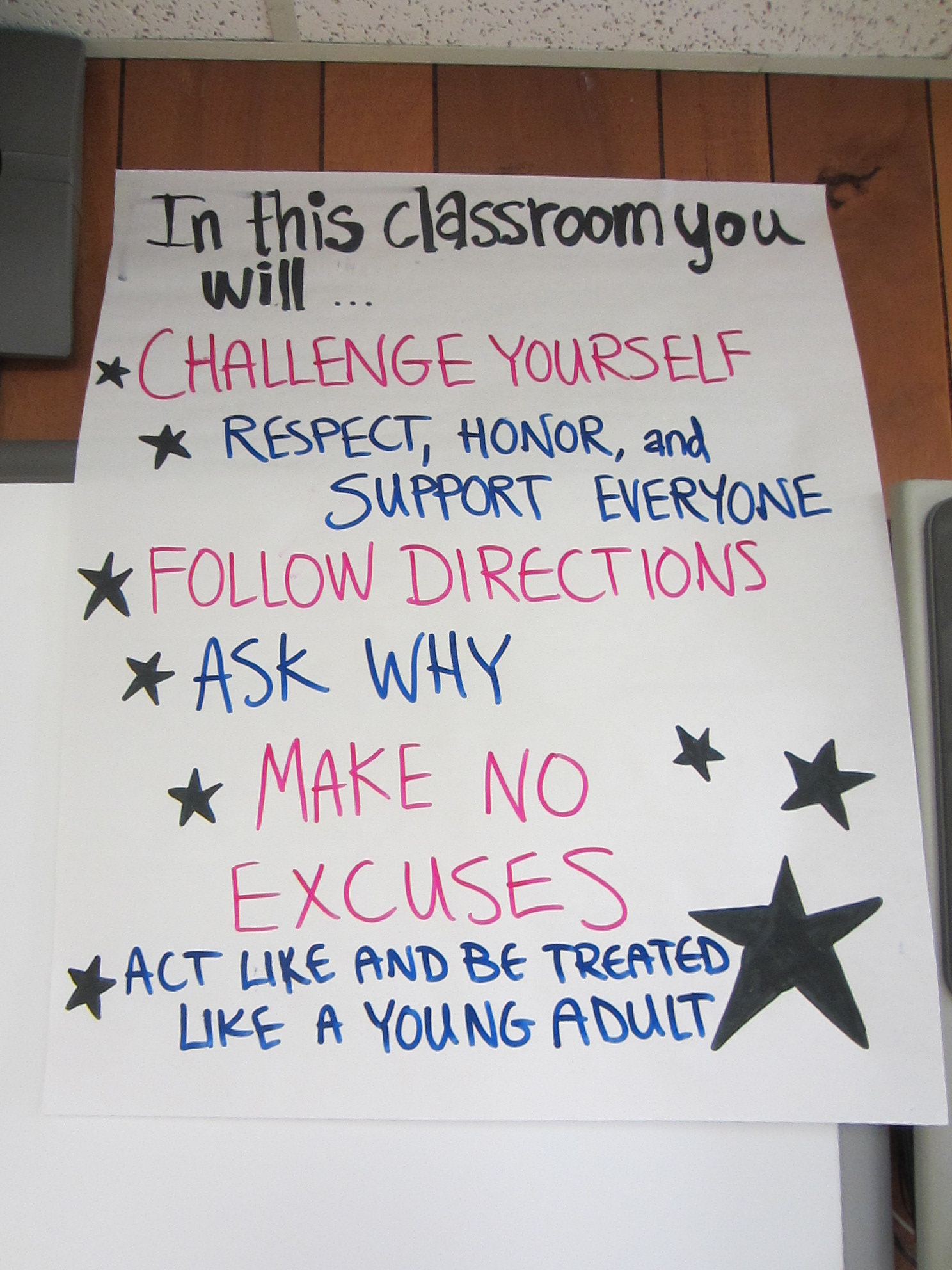
Crowning moments of the day:
Days like this make me love my job. Days like Monday make me want to flip burgers. Teaching is awesome, but by golly it’s no cakewalk.
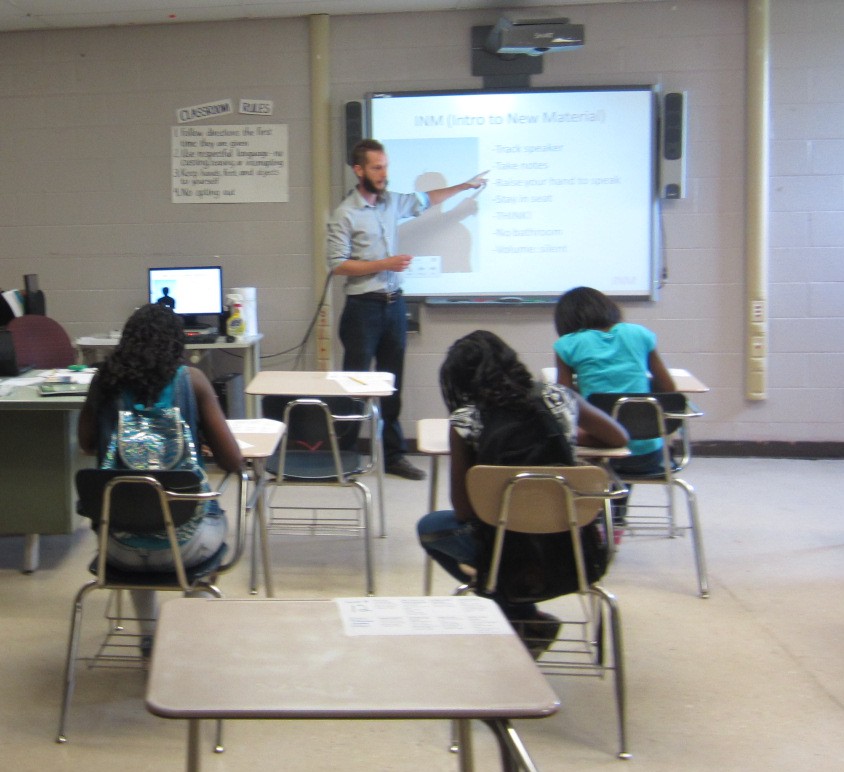
Here’s a snap of Mr. P in action.