Solstice

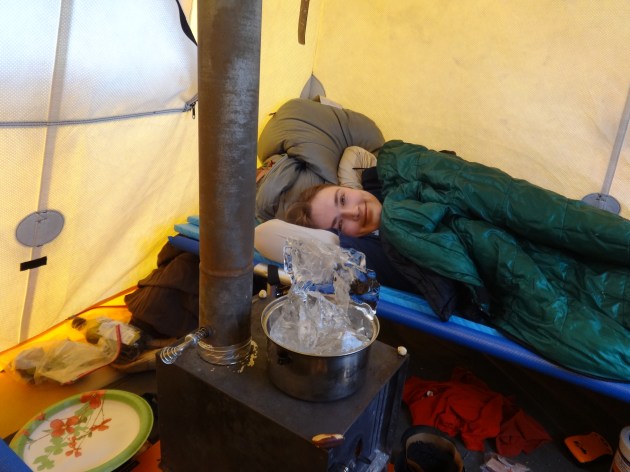
Yesterday, I went out alone to bring in the tent.

This seems like a small thing, but I rarely go out alone, and when I do I never go very far from the village. I wanted this independence, this next test, but I was hesitant. I would have to go out beyond my comfort zone on the snowmachine (a vehicle I’m still new to) while hauling a sled (for the first time) and do a demanding chore alone in the cold. A chore I’d never done before at all – the tent had been out there since September, when we brought it out by canoe, and I’d only ever helped put it up last year. Geoff always went back to take it down alone.

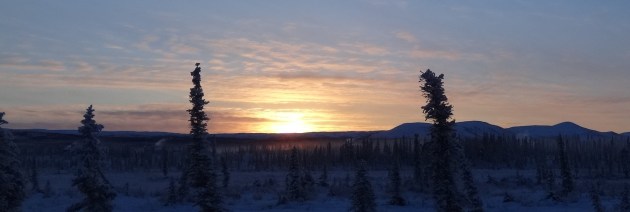
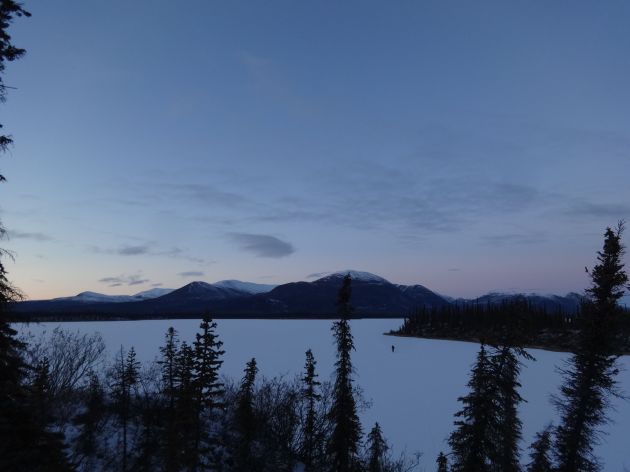
My heart was in my throat the whole way across Maggie Lake (I broke my own trail through the fluffy new snow). I had to bushwhack up through a slough and onto the hill where the tent was pitched, and I’d never done much bushwhacking on the snowmachine, so it was exhilarating and terrifying. When I got to camp, startled to be there with so little trouble, not having hit a tree or flipped the sled, I shut down the Bravo (bangbang, bang… bang). The silence fell in on my shoulders like the snow.

And it was fine. Lovely, even. I didn’t spend the whole time looking over my shoulder for lions, tigers and bears. I worked. I had to hammer and dig and chip and lever every stake out of the frozen tundra. I stripped out of my coat and let the falling snow melt on my long-johns. It melted on my hands, too, and when I dismantled the stove, my bare fingers stuck to the metal and popped off – puck puck puck. I put my gloves back on, after a moment or two of that.

I rode in at dusk (it’s always dusk when it’s not night, but I mean around 3:00) without too much trouble. I hit a stump and nearly got bucked off, and there was that steep bit in the bushes where I thought the machine might pitchpole, so I walked alongside, but, all things considered, it was a roaring success. I could do it again.

How awesome is that?

Happy Solstice, everybody.

Keely (newly minted junior varsity arctic badass)

Venetie Volleyball

On Thursday, six kids from Venetie flew to Arctic Village to play volleyball. We’ve been planning this for a while with their principal, and I’ve been looking forward to it since it was just the germ of an idea.

dsc05371

Venetie and Arctic have a complex relationship. They are partners in land ownership and governance, but there is some animosity between them. Arctic gets a lot of visitors and attention from outside, and I think there’s a perception in Venetie that Arctic is kind of stuck up. Venetie is a rougher village. There seems to be more crime and drinking and ugliness there (though I am not convinced that this is as it seems). Arctic kids grow up with an aversion to things Venetie. When I wore my Wolfpack hoodie this fall, they would call me a “mutt” and make rude comments about people from Venetie. The kids from the two villages snipe at each other over social media, even though they have hardly met in person.

I love those Venetie kids wholeheartedly. I latched on to them over the year and a half I was their teacher, and they mean the moon to me. When kids here say unkind things about them (people from Venetie suck: so and so is mean) I take it pretty hard. This visit was an opportunity to chip away at that prejudice a little.

Thursday, we mixed the groups and played Shipwreck, a team building game where you have to get everyone on your team across the gym before the other team. The challenge: the floor is lava. We gave them tools, (rope, hula hoops, a single roller skate, a scooter) and we set up a few islands. It was great watching them solve problems and come up with creative ways to use the items.

Later, we had them work in teams to make and clean up after a shared dinner, and after dinner we opened the gym for casual volleyball for a few hours. Geoff and I had ordered a glow-in the dark ball, and I had all the kids sign it with highlighters. We set up black-lights on the stanchions and passed out glow sticks for wristbands, then turned out the gym lights. It was pretty spectacular. G’s teeth glowed in the blacklight.

Friday was tournament day, and there was a lot to do, but we took the afternoon off from preparations to get out and enjoy the suddenly warm (-15?) weather. I set some kids up with skis during PE and Geoff set some others up with snowboards. At 1:30 we headed out to the lake. The truck dropped us off beyond the airport, and we skied or walked the rest of the way.
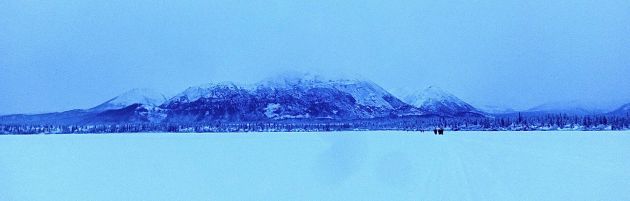
dsc05374

I skied, and it was blissful. It’s been too cold to ski most of this winter, not because I’m a pansy but because there’s a temperature at which skis just stick instead of gliding. I pulled ahead of the kids and took a picture of them all trekking in the snowmachine trail across the lake to the spot Geoff had chosen for a fire.
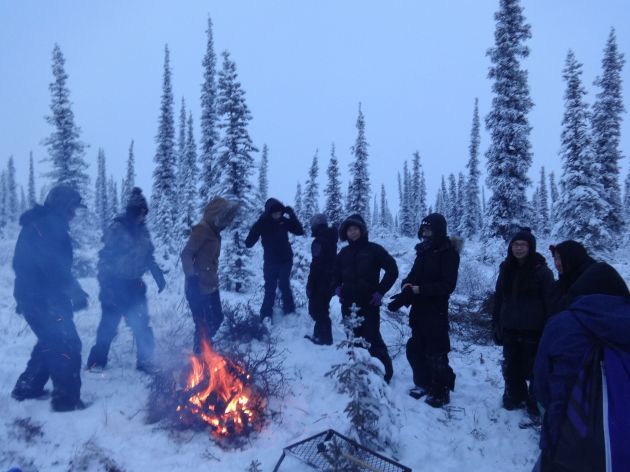
dsc05375Geoff drove his snowmachine back and forth, picking up kids in the sled and hauling them out to the fire. I bummed a ride down the lake and back once, before all the kids lined up to try it, whether on snowboards or skis. L was awesome on a snowboard. dsc05384They heckled Eddie, the principal from Venetie, until he got on a snowboard and gave it a try. C, a 7th grader from Arctic, rode backwards on the machine behind Geoff, giggling. The kids kept a great fire going the whole time, and heated water for tea. Everyone had a blast, and no one complained about the long walk out or the chilly ride back to school in the back of the truck.

dsc05379

We were all exhausted by the time we got back to school, but the day’s activities weren’t done. I led a team in pizza-making, and sweet P from Venetie made cake for everyone to share.

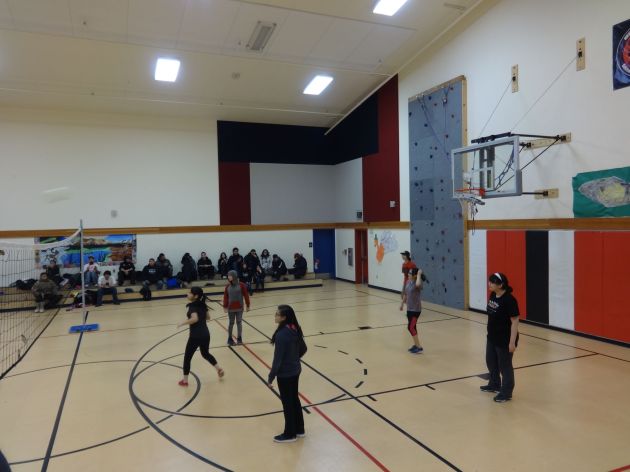
After dinner, the moment was finally upon us. We scrambled to figure out the scoreboard, find a whistle, and organize the kids into reasonable teams (we had to have two teams from Arctic). At 7:30, the games began.

Folks from the village showed up and cheered for both teams, which made me glad. I admit to secretly cheering for the Venetie kids: I could see their nerves, their courage, and their determination clearly on their well-loved faces, whereas the Arctic kids were perfectly relaxed and at home. All the kids played great games, with Venetie losing to both Arctic teams by only a point or two.

After the two schools played, a village team was organized, and they played a few games against mixed student teams. I like that the kids ended the volleyball tournament by playing together. It reinforced what the trip was supposed to be all about (in my mind).
dsc05396

The kids stayed and watched a movie in my classroom until midnight. I was dragging by that time, completely done-in by the long days. When the Arctic kids finally went home and the Venetie kids finally headed to bed (“bye,” said G as the Arctic kids put on their snowpants in the hall, “it was really nice to meet you”), I was more than ready to get home and into my warm, blessedly horizontal bed.

In the morning, I went over to the school to have breakfast with the Venetie kiddos before the plane came. They were still sleeping when I got there, so I got to read the note they’d written on my board and leak some tears before they woke up.

dsc05403

A few Arctic kids showed up for breakfast, but they didn’t stay long, so I got to spend a little alone-time with my girls, and that meant a lot to me. The relationship I have with them is nothing like my relationship with the kids here. They feel more like family than like students, and I told them how proud I am of their courage, grace and humor. They gave me all the gossip – who has a new baby in the village, which Venetie girl has a crush on which Arctic boy and so on. A has matured so much since last year, and she is standing up straighter, proud of her bright mind and smile. G has grown into her height – she’s become a confident, stunning young woman. P is so much less volatile now, and she lets her kindness show through more. As usual, C is perfectly herself. I’ve really missed them.

Arctic is traveling to Venetie for a rematch in the spring. The girls are determined to give us a warm welcome and show us a good time. I can’t wait to visit and see what they come up with.


Shook-up world: What is the value of wilderness?

Like so many people, I am dazed by the events of this week. On Tuesday night I went to bed in tears, shocked and frightened by the outcome of the election. Trump’s campaign always felt like a prank to me, and now it feels like a prank that got out of control and set fire to the house with all of us trapped inside.

My fear stems from the following:

  • We have just sent a message to every secretly bigoted and misogynistic creep on earth that we, as a nation, condone abusive behavior and expressions of prejudice. This, more than anything else, frightens me.
  • I heard yesterday that Mr. Trump has expressed an interest in allying with Russia in Syria. Although I thought I remembered hearing that Russia was no longer backing Assad, I couldn’t find anything in a short online search to confirm that recollection. It is horrifying to think that our country might lend support to a criminal head-of-state who has used chemical weapons against his own people.
  • We have empowered a science-denier to make policy decisions that will have an irreversible impact on the environment.
  • Mr. Trump will have the opportunity to appoint as many as three supreme court justices.
  • Mr Trump will appoint a cabinet. I keep hearing rumors of a Secretary of the Interior with oil interests (Forrest Lucas, Sarah Palin) and an Energy Secretary with financial interests in fracking and in the Dakota Access Pipeline (Harold Hamm). I’m trembling here at the hem of ANWR.
    I understand that our Department of the Interior is responsible for managing federal lands in the best interest of the American people, for industry and recreation as well as conservation, but I am not convinced that the economic and political benefits of developing oil and natural gas are always worth the price we pay.I have not been persuaded that the potential benefits of developing mineral resources in ANWR outweigh the potential cultural and environmental costs. I know that this state runs on oil money and that my job and many, many others depend either directly on the oil industry or on the state budget. I know that it has never been demonstrated that the Porcupine caribou herd would be disrupted by development in the 1002 area. I know that the pipeline needs to maintain a minimum pressure or be permanently dismantled, and that with Prudhoe Bay producing less than in previous years, we need a new source for oil if we want to keep it open. I know that Alaska Senator Lisa Murkowski has vowed to open the 1002 area in ANWR for drilling, and there will never be a better opportunity.  I expect the onslaught to be immediate and forceful, and I know that my students and their families are not prepared for it.

I’m trying to channel my anxiety into action. I’m reading endless articles and teaching my class with a renewed passion for civics. I am trying to cultivate a diversity of nuanced opinions among my students, who are usually, to their detriment, of one mind. I told the kids today, as I have been telling them for months, to bring me their voter cards when they turn eighteen and I’ll bake them each a cake to celebrate their power. I want the kids to know how the government works and how to influence it. I want to spend the next four years building up to a huge celebration of the centennial of women’s suffrage. I want to get my students informed about Standing Rock and the Dakota Access Pipeline and in contact with native kids, like them, whose environment and heritage may be threatened by oil development. I also want them to understand – really understand – the perspectives of people who don’t share their views, including those who wish to develop oil resources. I have never been so motivated to get my students writing clear, cogent, persuasive essays. We have such a long way to go, though. They are miles behind and not catching up quick.

But, after all, why bother with all of that? What is the value of wilderness?

dsc05351

Wilderness is valuable for its power to make us feel small. We spend so much time in human-built environments, perfectly made to our scale, that we forget how we diminish in the presence of  mountains and tundra, how we disappear in the course of rivers that churn with mud and power. When I am out there, I am no greater than one of seven-billion ice-crystals lying under an unknowably deep and vast sky.

It is valuable for its beauty, if you believe that beauty has value.

It is valuable for subsistence and cultural diversity, if you believe that subsistence and cultural diversity have value.

It is empowering.
How does it feel to stand in a silent, snow-filled valley, hundreds of miles from anywhere?
It feels like hugging the sun.

It is valuable for its complexity. As Carl Sagan reminds us, “The beauty of a living thing is not the atoms that go into it, but the way those atoms are put together” (thank you, Symphony of Science). We have so much yet to learn from the systems that interconnect in wild places. It is not enough to take pictures and samples to fossilize in a lab somewhere: the complexity of nature demands space, time and variables that cannot be simulated or artificially preserved. By eliminating wilderness, we preclude the full expression of these complex systems and curtail our studies and potential scientific knowledge.

The variation – the biodiversity – that powers the miracle of evolution also powers the miracles of medicine and technology: we look to biology and ecology for answers to our most difficult human challenges, and, without wilderness, those answers have no place to live.

And what about this wilderness? The Arctic National Wildlife Refuge? What is its value, specifically? I try to be pragmatic, and I think I am. I can see my way all the way around most political issues. I can see what people who want to develop the resources in the 1002 area see. Economic growth is important. Jobs are important. Energy independence is important. But vast, untouched and untouchable wilderness is inherently valuable for its power to command our respect and awe. Arctic beauty is important, more so as it dwindles. Culture and caribou are important. Unique biological and ecological processes and systems are important. And the only difference that really matters between these things and those things is that these things are available nowhere else in the world.

If by cultivating economic growth, jobs, and energy independence we compromise the biodiversity and cultural diversity of the planet, we pay too high a price.

In other news, ahshii. It’s snowing.

At last.

ice

dsc05280

With no snow on the ground and the lake frozen solid, we had to get creative about drinking water last weekend.

dsc05272

Geoff chopped a supply of ice out of the slough and the fragments littering the surface made walking treacherous and hilarious.

dsc05286

Icebergs make the best drinking water.