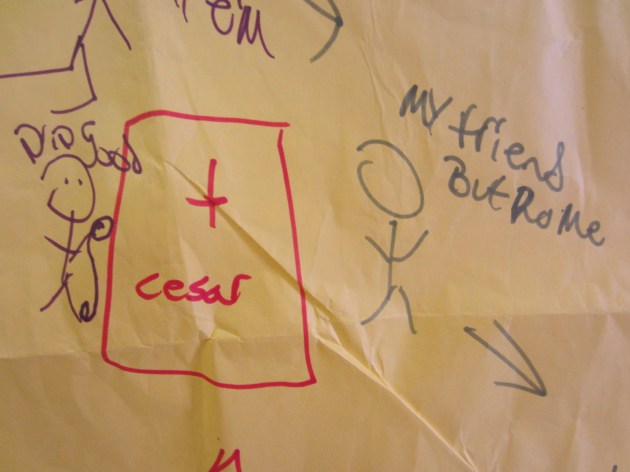
I’m not yelling!

It was sixth period. The noise level in my classroom slowly ratcheted up and stayed up. The leader of this particular, subtle coup sat with a smug little grin on his face and chatted with his friends while he tried (perhaps pretended to try) to do his work. I should have spoken to him sooner, but I was preoccupied by helping students who really needed help at the other end of the classroom. Have you ever noticed that they group kids with behavior issues and kids who need a lot of support together, to the effect that nobody in that period learns anything at all? by the time I reached the now loud and totally off-task child, I was frustrated and I jumped a rung on the consequence ladder. After an initial outburst before I reminded him of protocol, he kept his feelings to himself and stayed after class to talk about it, which is exactly what I want kids to do when they think I’m being unfair.

“Did you want to talk to me?”
“Yes I did. You treated me unfairly.”
“You were not following directions.”
“Neither was anyone else.”
“That’s because you’re a leader! You’re smart and respected! When you’re off-task, people think it’s okay to be off-task. Help me lead this class in a way that allows people to learn”
“Just because I’m a leader doesn’t mean you can treat me differently. I didn’t even get a warning!”
“I spoke to you several times, though.”
“What about [he named several students who had been talking]? They didn’t get detention.”
“I couldn’t hear them talking from the other end of the room. They didn’t start a shockwave of off-topic chatter”
“It’s not my fault I have a loud voice!” (he was yelling)
“Please don’t yell at me.”
“I’m not yelling!”
“You will be here for your detention on Monday” (I was yelling)
“Okay” (he stalked out with a look of total disgust)

By this time, my 7th period had come in. They were seated, silent and bug-eyed. My eyes welled up. “Get to work on the do-now, guys. I’ll be right back.” I stepped into the hallway and slumped against a bank of lockers with a clang, trying to keep myself from howling. Two kids stopped in the hall to ask what was wrong and to tell me they loved me. When I went back to my class, face all blotchy and puffy, a girl got up and hugged me tightly. I took some deep breaths and taught, but I felt sick with self-loathing, and every once in a while my eyes would spill over. That class was dismissed early for a pep rally, and I sat with the kids in the bleachers, trying to be inconspicuously devastated while the cheerleaders got fired up.

“We’ve got spirit, yes we do, we’ve got spirit how ’bout you?”
“…”

I spotted my young insurrectionist a few rows behind me, and when I felt I had some dry-eyed minutes, I nudged another ninth grader aside and sat down next to him.

“I’m sorry I yelled at you. I shouldn’t have done that.”
“Y’know, don’t worry about it Ms. O’Connell. I’m used to it.”
“That doesn’t make it okay. Besides, you were right; I should have given you a warning.”
“It’s okay. Just don’t worry about it.”
“I am worried about it. It’s important to me that I treat people fairly, and it’s important to me that you feel respected. I’ll do better on Monday, so be ready for those warnings. They’ll be coming down like rain. Forget about that detention.”
“Okay.”
“Have a good weekend”
“You too.”

I went back to my seat and, mercifully, the pep rally ended. The kids trickled out of the bleachers to their cars and buses and I sat alone at the top of the stands, letting the scorching sun dry me up. When it got too hot, I walked across the grass and unrolled a yoga mat on the floor of Vanessa’s classroom trailer, and she and the color guard said sweet things and soothed me. A student of mine found me there. He got down under the table next to me and asked if he could have his confiscated phone back.  I told him where it was, and his casual manner and good humor made me laugh. Soon I was vertical, and after a while I went back to my classroom, fed Buggy (the baby mourning dove that I’ve been looking after), visited with A (my second little brother from last year) and hopped in the car to go home.

I’d be lying if I said I didn’t muddy up the dusty dashboard with some tears on the road.

I can think of a hundred ways that I could have prevented or defused the situation with the loud young man, but I was exhausted, both physically and emotionally, and I didn’t have the presence of mind to stop digging myself a deeper hole. I think I did right by apologizing. I don’t feel sick when I think about it, and I’m not dreading seeing the kid tomorrow. I know he’s clever and I know he has a strong sense of right and wrong. If I treat him with dignity and respect, I think I’ll have a great ally, and I think he’ll learn more from me than he would if I just smashed him flat with my consequences every day until he behaved out of fear. I hope he won’t take my apology as a show of weakness. I think humility takes considerable strength, and I try to recognize that in people, but that’s a realization I came to well after ninth grade. We’ll see.

I love teaching, even on days when I don’t get to eat my lunch because I’m tutoring, or I’m on duty, or someone has challenged me to a Stratego show-down. I love it even on days when I can’t find time to pee so I have to hold it for half the day, and on days when I can’t be alone to bawl for a five minutes, so I spend two hours pushing down sobs. I love it on days when it feels like no one else is doing their job, and I love it on days when it feels impossible to do mine.  I have the chance, every single day, even (especially?) on the worst ones, to humanize and to empower and to be humanized and empowered in return.
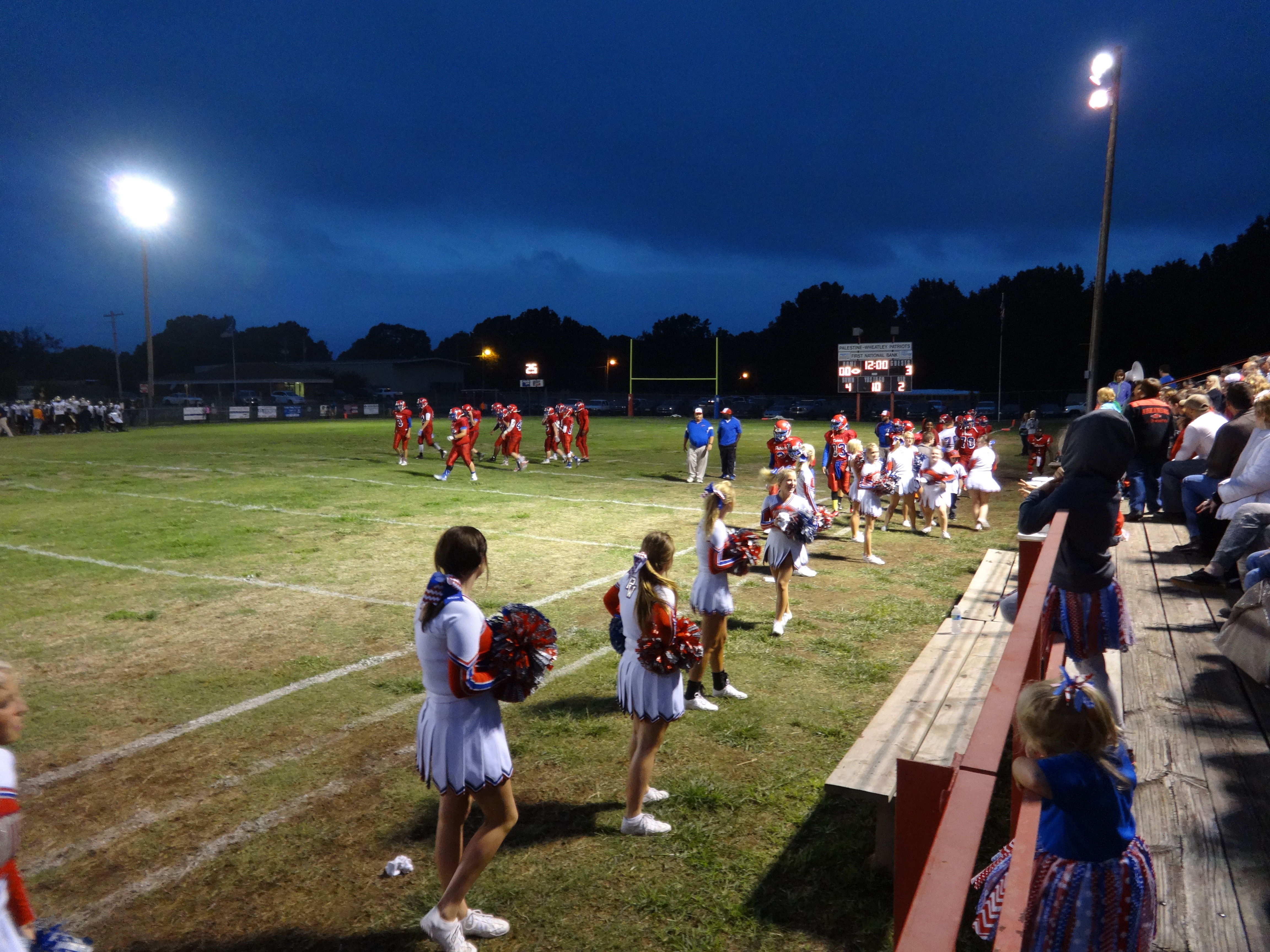
DSC00313

I have taught and loved every cheerleader and football player in this photo; the fellow with the sousaphone, too. Thanks for the hugs on Friday, guys. You don’t know what it means to me.
Balance

I have thought a lot this summer about quitting my job. If I were to quit, I could stop slogging through variables and decimals amid the wails of the oppressed youth of America and do something that enchants me for a change. I could learn woodworking or go sailing or live abroad. Quitting wouldn’t cause any major financial hardship if I took on occasional substitute gigs and tutoring opportunities. I could lace up my boots and get my fingers all sticky and frown over art problems and remember what it feels like to be free.

We’re two weeks into this year, and already I can feel a growing knot of stress under my right shoulder blade. My stomach has stopped recognizing familiar foods and has turned gizzard on gravel over red onions and pineapple. School exhausts me: I come home tired, and I don’t sleep well. The emotional drain is a 72 inch pipe in the bottom of my reservoir, and my hundred and twenty kids are Dallas. I hate that even in a good week, I can only hope to fail well every day. In a bad week, the Sisyphean nature of teaching takes its toll and I get smashed flat as everything I’ve worked for unspools at the feet of a school system already so bewildered by bureaucratic inefficiency that it can offer up only the feeblest of support.

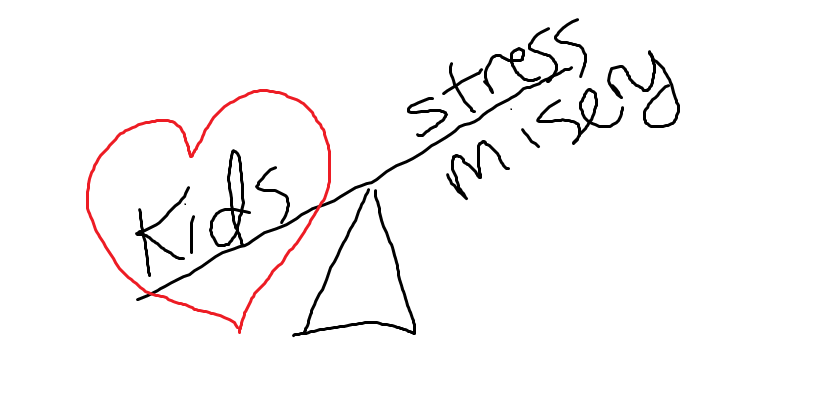
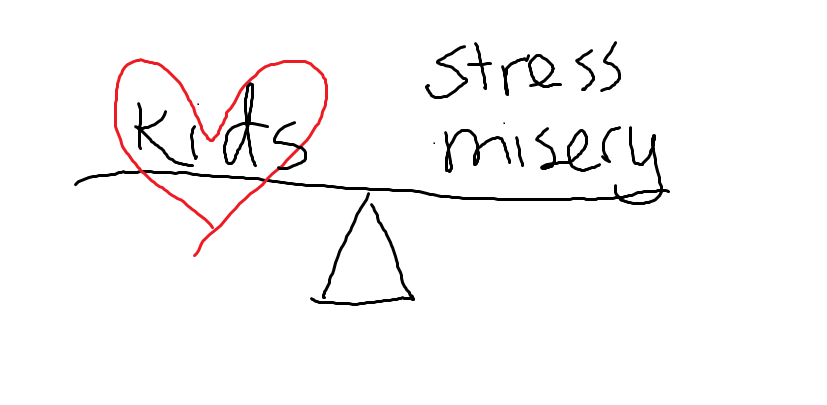
I haven’t quit yet, and the reasons why are all between the ages of fourteen and eighteen. This is hard, stressful, unsatisfactory, unsupported work, but it is a labor of tremendous love, and the kids make me smile, even on the worst days. Until recently, there could have been no question at all of my quitting.

For the past two years, my kids easily outweighed all of the hardship attendant with the job.

For the past two years, my kids easily outweighed all of the hardship attendant with the job.

Now, I’m teetering on the edge of a choice that I don’t want to make.

I'm not sure which weighs heavier on my heart.

I’m not sure which weighs heavier on my heart.

At what point do the personal consequences outweigh the value of the ethical work that I’m engaged in? At what point does self-sacrifice become needless and stupid? I love teaching kids, but I feel that I’m being asked to do it under untenable conditions, and that my willingness to go all-in is being abused. Kid-love is a variable, and some days it’s abundantly clear that it’s not enough. Other days, a sweet bit of graffiti blows the k-factor through the roof.modd

A Day in the Life (Summer School Edition)

5:50 a.m.  I try to wake up and start my run before I realize what I’m doing. Sean stays in bed, letting the sun pink the walls slowly as he eases into the day. Usually by the time I wake up fully, the sun is just breaking over the trees and I’m smiling, halfway down the road. I try to push my distance a little every day, to run the length of that sorghum field, to circle that pole barn, to turn around at that road cut. This morning, I startled a young possum in the ditch and was myself startled by a rattlesnake, as big around as my bicep, curled dead in the road.
I come home, shower, and get dressed in my teacher uniform: usually a skirt, a t-shirt, flats, and earrings. Sean packs my laptop, a waterbottle and a banana in my bag and pops in a bagel for me. At 7:00, we’re out the door.

7:45 a.m.  Papers laid out, pencils sharpened, we’re in the cafeteria, watching the kids eat breakfast, breathless from the whirlwind of copying and tidying before class. At 8:00 we walk our groups to our respective classrooms, and teach for two 90 minute blocks with a thirty minute recess in the middle where we supervise the kids on the patio. The first few minutes of class is always a push to get kids settled and working on their do now/bellwork/entry task. The bells don’t ring during summer school, so there’s no distinct start to class, and kids take advantage of that blurred line. Someone is usually singing or building a paper airplane or pretending they can’t find a pencil or paper (I provide them: they’re right in front of you, dingbat), or squabbling about a seat. After bellwork, we get rolling with a discussion or experiment and I get them going on a problem or a problem set within ten minutes. At Lee, I’ve found I can count on about a three-minute class-wide attention span. I’ve got ten at Palestine, but I have more relationships, authority, and reputation up there. I break up the work-time accordingly, so we review problems frequently and I give plenty of opportunities for kids to talk math. It looks like mayhem, but it works pretty well. I did a bangup job of captaining my team to victory over function notation today. The most fabulous disruption of the day was this:

I’m assisting a student on one side of the classroom.
A student asks permission and then gets up to sharpen his pencil.
There’s a commotion on the other side of the classroom from me, near the pencil sharpener.
K: Whoah! he’s getting sexual over here!
R: did you see – he – he – he tried to kiss me!
J: (from across the room) BWAKAHAHAHAHA  — HE’S GETTING SEXUAL!
I glare at J and she turns down the volume
M: I didn’t try to kiss him! I was just making kissy noises! (Makes kissy noises)
J: (from across the room) OMG (Makes unreasonably loud kissy noises)
R: He tried to kiss my EAR!

12:00  It’s hot at noon in Marianna. It’s really, really hot. I get headaches and I sweat like pigs would sweat if they could (they can’t). We wait outside on a covered walkway for the buses to come after lunch, and keep kids from hurting each other or sneaking away to do who-knows-what behind the building. It’s a steam-mirage of sneakers smacking the concrete, yellow buses, sticky blacktop, yelling voices, sweat. At 12:30 we get to leave, and it’s a horrible relief to sink into the soft passenger’s seat of the Nissan: a relief because I’ve been on my feet for six hours already, horrible because our car is black and the inside at noon is hot enough to explode cans of soda (true) and melt rubber bands (true). Sean starts the car and we crank the A/C. It roars and sputters and blows hot air like a salon for the first few minutes, then blessed cold. By the time we’re halfway home, we can turn it down to half-power.

1:00 p.m.  It’s too hot to work outside. Sean fixes us lunch and I spend a few hours in the afternoon each day working on indoor projects: canning, tanning, lesson planning. I do some dishes, dick around on the internet, read a little, tidy something somewhere, check on the chickens, and suddenly it’s sunset, and well past time to think about dinner. Sometimes, we manage to work in the garden for a while, but lately it has not cooled off until just before dawn, and gardening in the afternoon in these conditions is out of the question.

8:30 p.m. Dinner is usually something wonderful: we rarely visit the store these days, so our meals are almost all Arkansas-grown. Tonight, it’s braised cabbage with green apples and caramelized onions, our cherry and tarragon turkey sausage, and cucumber, basil and mint salad with slivers of red onion. Not from here: red onion, green apple. We eat on the futon under the clicking ceiling fan and watch a movie or an episode of something (Freaks and Geeks, tonight) with the volume up to drown out the window unit that growls in the background.

900 p.m. It’s storming and, inevitably, there’s a crisis. Sean goes down to check on the pigs and I hear him hollering over the thunder. I rush to the porch door and peer out through the curtain of rain, looking for the flashlight.
“are you there, Sean?”
a flicker of light through the six-foot tall jungle of wet grass
“yes but the pigs aren’t. I can’t find them anywhere.”
Sean slumps up to the steps, exhausted at the prospect of the wet, muddy search ahead, and I’m ready to head in and grab my coat when there’s an unmistakable grunt from under the porch, then a chorus of snurfles. The pigs are under the porch, sheltering from the storm.

10:00 p.m. late, cold dinner. Turns out, there’s not a damn thing you can do to move a 150 lb pig that doesn’t want to go out in the rain. Damn. They’ll be there in the morning, the impudent swine.