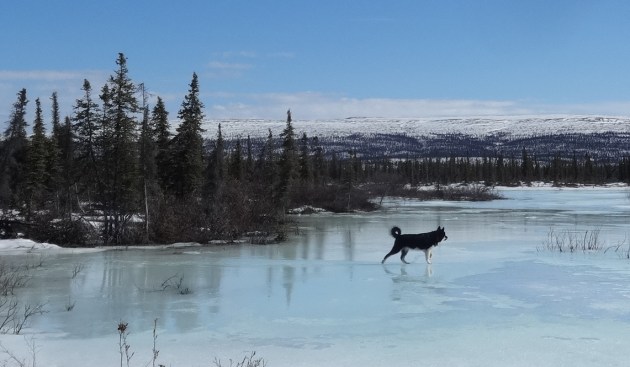
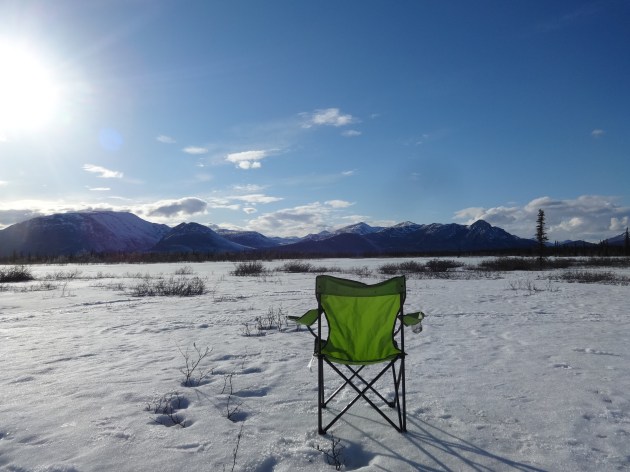
Roof Leopards

Geoff took off on Wednesday to run spring errands and get his teeth fixed, so I’ve been holding down the fort for a few days. I like the quiet, but I’m ready for him to be back in action. Things are thawing out, and I can’t keep up with all the melting on my own.

We brought home a couple of caribou two weeks ago, and when Geoff left we’d taken care of most of the meat, but still had a couple ribcages and three legs to process. Sure enough, when I got home from school that day, slipping and slushing all the way in bunny boots and a sweatshirt, the meat in the snowbank beside the house – a reliable freezer all winter long – was soft to the touch.

Work gloves on, I grabbed a caribou (minus its legs – what would you call that?) and hoisted the drippy ribs into my arms, up the steps and onto the table. I stayed up late processing (and marathon watching MASH). I got a good bit done, but the backstraps were still frozen into the spine when I went to bed at midnight, so I left the long, curving backbone, now sans ribs, lying on the table to thaw until morning. Daazhraii gave me good cuddles and I slept well in the unmistakable quiet half-light of an arctic spring night.

Most mornings, Geoff wakes me up around 7:30 and we make it to school just before 8:00. When he’s gone, I am on my own, and it’s actually kind of hard. I don’t have an alarm clock or a phone that will work as one, so I just sorta hope for the best and ask Geoff to try and remember to call me. Thursday morning, I woke to the ringing of a phone, so I jumped out of the covers to run down from the loft and answer it. I couldn’t find it, but when I looked at the clock I read the fatal hour: 7:30. I raced through morning chores in the broad daylight of a high spring morning: feeding the dog, picking out some clothes to wear, brushing my teeth because somehow my school toothbrush went missing last week (WHYYY???), cutting, bagging and tagging the backstraps, and stashing the rest of the spine in the snow beside the house. I fired up the snowmachine and cursed when it wouldn’t move, then realized it was frozen to the ground and kicked each ski loose. When I got to school, the door was locked and no one was there.

I parked the sno-go and put the dog on his run. “Did people think with Geoff and Mark gone, we had to cancel school, Shoopie? Where the heck is everybody? It has to be five after.”

It was, of course. Five after seven. I haven’t been that early to school all year.

At least I got a shower that day.

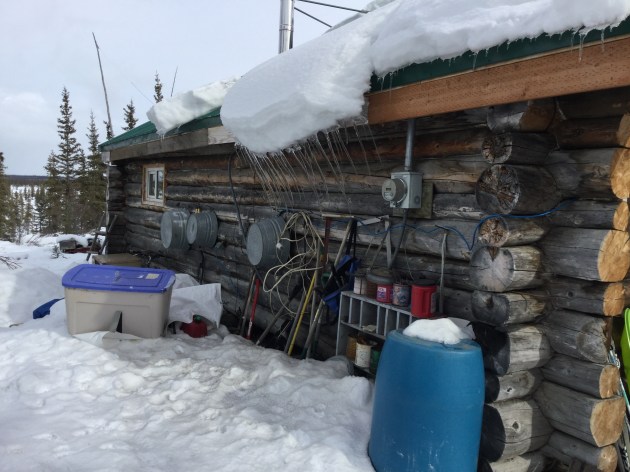
That evening after school, I went to check on the status of the caribou meat piled in the dwindling snowbank on the north side of the cabin. I stepped around the corner and almost got mauled by a half-ton sheet of snow with foot-long icicle teeth that picked that moment to slide (pounce?) off the roof. My scream brought the dog around, and he glued himself to my knees until he was satisfied that I was, in fact, unharmed.

The snow buried the tarp that covered the meat, so I left it, figuring the extra insulation would keep the cold in. Maybe also because I didn’t want to play tackle football with that particular snow leopard.

A4FF4AB5-5757-4368-8BCF-28096199F4CB

I Won!

Just so that everyone knows, I beat this (charming) person’s butt fair and square in a tea-making contest this weekend.

GeoffJunjik.jpg

The loser. He doesn’t look too miserable.

Tea-making is a spring carnival race that I’m planning on entering this year (along with the egg toss, and perhaps the snowshoe race), so I spent some of the weekend getting practice. I lit two sturdy little fires on Saturday, then challenged Geoff to a race on Sunday.

The idea is, you race to be the first to get water to a rolling boil in your pot. You get an axe and a knife and a lighter and some dry wood and go to town, huffing and puffing and panicking. I burned off some of the wispy hair that sticks out from under my hat this weekend.

The real deal race is Thursday, and I’m sure to embarrass myself magnificently in front of the whole village.

Wish me luck.

April Came Early

keelycamp

April in March

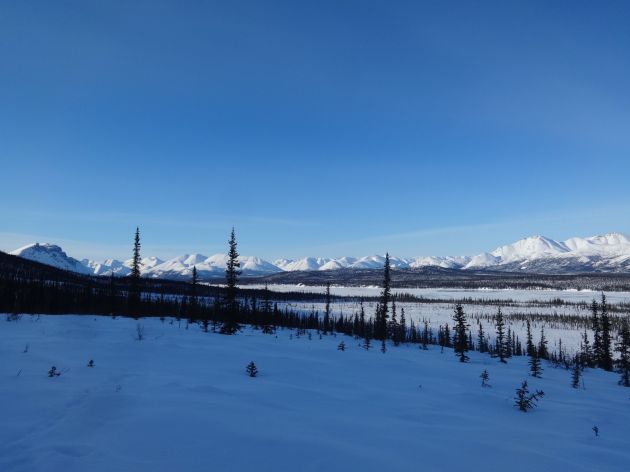
April came early this year. Weeks ago, we had the long, snow-bright evenings and the warm afternoons with slick trails that characterize my favorite month in the Arctic. There has to be a word for this time of year in Gwich’in. I will ask Albert, someday. Birds start to appear, the little songbirds that seem to erupt from nowhere – how do they survive the winter? – and it’s finally time to ski – I have the bruises to prove it: I wiped out spectacularly last weekend.

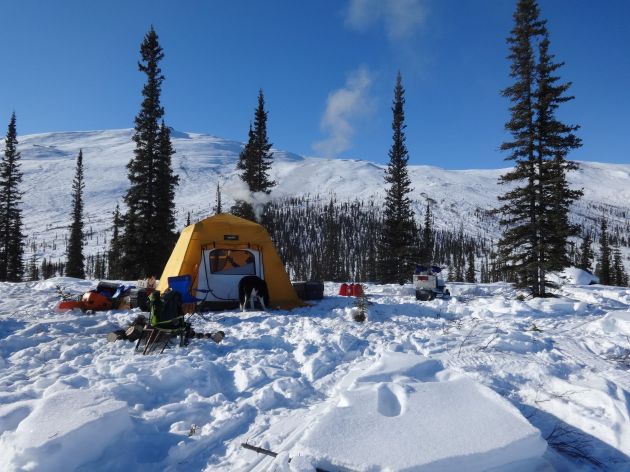
Right now, my tent overlooks the Junjik valley. It’s positioned so that we can spy on the overflowing river valley with binoculars, can see Nitsih Ddhaa from our sleeping bags, and so that every pop of the lively ice below echoes through our camp. It’s also halfway up a little mountain.

junjikrockcamp

We headed out to camp last Saturday night after Geoff welded his snowmachine back together (His Skandic has been falling to pieces this spring. Every time we go out it’s something new – a swing arm, a belt, an exploded bearing, a broken exhaust… Sassy Bravo has been reliable, except for – ehrm – user error and the headlight thing, and what’s the point of fixing that now, anyway, when we have some fifteen hours of daylight?). I skied out ahead with the dog loose beside me. The creek at the border of the refuge was overflowing and drenched with the pink of the evening sky. I picked a path across, careful to keep my skis dry, and slogged through the thigh-deep drift on the far bank to regain the trail. Daazhraii and I skied on – I love how I lose myself in the slip and glide of it all as the light fades from the snow – and I changed into my heavier gear when Geoff caught up, a few miles down the trail on Cargo Lake.

The moon rose full and yellow in a notch to the east as we floated up the Chandalar valley. It vanished behind the mountains and then rose again above them, irrepressible as a hot air balloon. In the long moonlight, I alternated staring out into the crosshatched night-woods, looking for caribou, and resting my cheek against Geoff’s back. It is still thirty below at night, and the wolverine ruff of his jacket is a soft shelter from the wind of travel. The lullaby hum of the engine, the glide of the track and the perfect unreality of the landscape in the moonlight make something like a magic carpet ride of the arctic night. Refuge indeed.

We crossed over two rivers and passed the open water in the Junjik, then climbed the steady, messy trail up the hill to the tent. At camp we discovered that someone had been there in our week’s absence, at least long enough to build a little fire and warm up. They zipped the tent all the way when they left, and added to our wood-pile. Later, Geoff found their trail to our north: two or more people hiking with sleds.

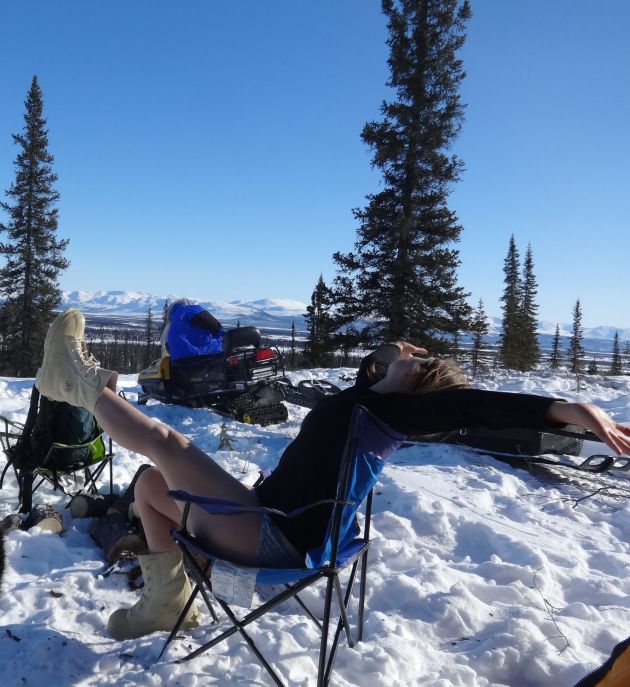
On Sunday, the wind blew steadily all day. Geoff took off to the north to break trail up the valley, and I stayed in camp, stitching a little on my beadwork, chopping firewood, listening to the wind hissing through the cold, skinny trees, and packing our gear. When he got back, Geoff went into the tent to thaw out and I slipped off on my skis toward town.

The wind was at my back, and on the better sections of trail I flew. It’s just that it’s such a long way down the mountain. Most of the downhill bits are ruts, paired with a little uphill at the end, so you don’t go too fast. There are sticks and willows that can snag skis, and bits where the trail splits or wavers over gullies. There was one long, straight section of trail that had no speed bumps. I saw it coming, knew I’d get going too fast, but I felt agile and bulletproof in my heavy winter gear and didn’t care. I kicked off and glided out and down, the wind pressing my blue windbreaker into my shoulders and my headlong rush pressing it into my chest. I accelerated, and the light glared hard off the snow into my squint. For long seconds I was rushing over the trail at what had to be the hull speed of my poor skis. I could feel every twig in the trail punching the hard soles of my boots. I made the first little curve, barely, and whistled on over another long, straight stretch. I dodged a willow wicket, a pothole. I pounded on and down, faster and harder until my knees ached. The wide valley below rose up, white and splendid, and then the second curve came, too sharp, too fast, and I bit it like a rhino on ice skates.

The valley floor was in my face, down my front. I stood up and the snow still reached my hips. I’d lost a ski. I had to unzip my bibs to empty the snow from my pants. The radio had flown out of my fanny-pack and landed down the trail a ways. The dog looked on, a little perturbed, the wind ruffling his pricked, concerned ears. I stagger-waded over and climbed up to the trail, picked up the radio, and dug around in the deep snow until I got lucky and unearthed my ski. Clipped in, I skied on across the flatter, more ski-friendly valley as far as the Junjik. Geoff picked me up on the river ice.


Some of you out there might know that I applied to the University of Alaska, Fairbanks, for an MFA in Creative Writing. Some of you might also know that I was accepted and offered a TA-ship, with attendant tuition waiver, stipend and medical. A few of you know how hard it was for me to decide what to do with that choice. In the end, after grappling with it and getting nowhere, I flipped a coin.

Tails.

I’m teaching in Arctic for one more school year; teaching, skiing, sewing, writing, cooking, kissing, fighting, chopping, boating, picking, building, shooting and living for one more year. I deferred, and I will be a student at UAF in the fall of 2019. With luck, I’ll be able to reapply for a TA-ship and receive a similar funding offer. And I am awfully lucky: look at where I get to spend the next year of my life.

junjikrockcamp2

Soft

Spring in the arctic is soft. It happens gently, so that without thinking too much about it you’re wearing your sneakers and then sandals to school every day and you’ve stopped building fires altogether. You can’t figure out how you could ever have been skiing on the same trail that is now six inches under water. Was that only last week? You go out to pee at two in the morning, it’s sunny with a pink glow to the north, and you can hear the river a quarter-mile away shushing like a giant slushie. Mud is everywhere. The dog dries out in the house and leaves sand art on the floor.

We had a beautiful final ride in ANWR a few weeks ago. There wasn’t much snow, but it was sunny and warm enough that wet boots didn’t matter too much.

DSC06117

Arctic Village is dealing with loss right now, and it is hard to know my place as a neighbor-teacher-outsider. I want to lend my strength as the community, especially the young people that I love, deals with grief and loss, but I am not confident that I know how.

The loss is twofold.

A few days ago, an elder passed away. “She was our oldest elder – she was 95!” L told me. Every such loss is tragic: elders have irreplaceable traditional knowledge and wisdom. This is a time of upheaval and change for Gwich’in people, and that knowledge and wisdom is a source of strength and hope. Such a loss is devastating for the community and for the culture.  “She died of a broken heart,” folks said, “she was so sad after what happened.”

A young man, twenty years old, her grandson, took his own life last week. I did not know him and do not know his family well. I do know the kids he grew up with, and I am afraid of the impact that this will have on them.

The suicide rate among Alaska Native men in their twenties is more than ten times the national average. I have heard more experienced teachers speak again and again about the domino effect that a suicide can have in a village.

It is not my place to try to explain this. Any explanation I tried to give would oversimplify a complicated story. My role in this is to help my students find empowerment in a very hard world.

But I have been bad at it.

When we found out what had happened, I held the older kids in my classroom so that we could insulate them from the tragedy for a few minutes. When adults from the village arrived, we (the staff and community-members) broke the news. After a few words and a few moments of silence, the other adults left, and I was alone with the kids. They were absolutely silent. I have never heard them like that.

“Do you want me to put on a movie so that you guys have something to zone out to, or is it better this way?”

“It’s better this way.”

That was my great offering. A movie. They sat for an hour until we dismissed school. Before they left, I told them that I loved them, but I could feel the words, like a stack of pancakes hitting the floor, falling flat for them in the empty air.

I have not been the best… what? this year. I was going to say teacher, but that’s not what I mean. I have been a perfectly good teacher. Maybe I have not been my best self this year. I have tried to do too much too fast. I spent a lot of time recovering from, planning for, or going on adventures. It has made me happy. But. In Venetie, I would have been giving that time to the kids – going walking or making cookies or working on the prom or planning awesome art projects. We built momentum, the kids and I. And that made me happy. This year, there have been no cookie nights. Nobody ever asked for them, and I felt it wasn’t quite right to offer. There was no prom. The play was awesome, a bright spark, but it wasn’t enough to get a real fire going.

If my heartfelt “I love you” fell flat for the kids, it was for the same reason that this school year fell flat for me: I didn’t give it the dimension that brought last year to life in Venetie: my personal time and space and passion. These are things that are not in my contract, that no one has the right to expect of me, but that, freely given, have let me fall in love with what I do and let me be who my kids need me to be.

I will not give up the time that I spend in the woods with Geoff and Daazhraii. That time makes the world crisp at the edges and centers me in myself.

DSC06134

I will not give up, the way I did this year, the commitment that brings my work to life for me and makes a real difference for the kids.

I haven’t figured it out, but I am facing the question: How do I give the kids the best of me without selling myself short? How do I get what I need and still give enough?

For Geoff, this spring was a bitter exploration of this question.

He got a letter late in March asking him (us) to stop traveling on tribal land without either obtaining permission from the council or bringing a tribal member.

He was devastated. Geoff has been camping and snowmachining in Arctic for several years now, and to suddenly have this happen was a real blow. It is hard to live in the village, fall in love with the land, give your time and energy to the kids – above the call of duty, and then have the rug swept out from under you. It makes you feel awful and unwelcome and unappreciated. It hurts.

We always try to be careful and respectful of the land and people. We don’t take wood from people’s wood yards or waste caribou meat. We never leave trash behind – we often pick it up.

I think it is evident in my writing that I feel a spectacular reverence for the lands and waters around Arctic Village.

But it is tribal land, and our traveling on it – our living on it, even – constitutes trespassing.

I never thought to ask if we were stepping on anyone’s toes. I guess we thought, if we thought about it at all, that our awesome work with the kids and our long-term residency exempted us from rules that might apply to, in Geoff’s words, “yahoos from Fairbanks who are just coming out for the weekend”

Privileged assumption much?

And yet.

What prompted this edict? It could be any of a number of things. I get lost in wormholes whenever I try to pin it down. A concern for our safety, a personal conflict, a kneejerk reaction, an exercise of authority, a bid for new revenue, a devotion to the rule of law, a sense of pride?

It makes me uncomfortable. I don’t like looking at myself as someone who has been kicked off of tribal land. I don’t think of myself as that disrespectful or inconsiderate.

And yet.

It’s not something I have the right to feel offended by.

The tribal government has the right to ask us to stop traveling outside the village on tribal land, plain and simple. It is fair, but it still stings.

So. We are writing a letter requesting permission to camp on the east bank of the Chandalar during our river trip this summer. We plan to invite Geoff’s good friend, a tribal member, to travel with us more, now that we have a second tent. As a gesture of goodwill and of our commitment to the kids, we donated a large sum to the student activities fund, which pays for student travel. Next year, regardless, we will travel primarily in ANWR. The land to our north is beautiful, and we have been talking about maybe shooting for the continental divide.

Right now, though, it is spring. I am in Fairbanks, hundreds of miles from all of my responsibilities and quandaries. I have the summer to grapple with the hard stuff. Maybe by fall I will have it figured out. Maybe.

Marten Lake or Bust. Seriously.

That Monday in March was probably one of the most beautiful days Geoff and I spent on the trail all winter. It was also one of the most frightening.

We woke up at Gweelah Camp and spent hours trying to thaw ourselves out. Geoff stepped straight into his forty-below boots that morning and it took a while for his feet to bounce back. We huddled over our low, damp fire, willing our clothes to dry, our toes to thaw, our water to boil. I felt brittle and stiff, like a frozen-solid sapling that snaps at a touch in the deep winter: the night before, huddled in that damp sleeping bag, was the closest I’ve ever come to truly, dangerously cold.

When we finally took off, we were low on fuel, low on really good food, and low on sleep. We had fifteen miles or so to go before Marten lake, and we felt sure now that there was no trail. I kept touching the package of toe warmers in the breast pocket of my bibs for reassurance. They were the last pair, and I’d been saving them against an emergency. They served as a kind of talisman: I knew I had five hours of comfortable feet, and as long as I could do without them, I had something in reserve.

The sun was blazing that day, setting the world to glittering in every direction. The ridgeline carried us like a rising swell over a sea of sparkling foam. We had sweeping views of the valley and the Chandalar, swirling against the foothills like a shining white pennant. The low hills rolled away from us in every direction and the mountains in the distance dazzled with searchlight-brilliant peaks. Daazhraii and I walked miles, all told, pushing ourselves to make up ground and help conserve fuel while Geoff broke trail ahead. I took no pictures, for some reason, but it’s clear and blinding-glossy in my memory.

When we crested the last ridge, we could see Marten lake far below in the valley. Dusk was falling, and the trail shot straight down the densely forested slope below. Geoff took us as far as he could, then left us again. I kept the puppy close as I walked, slower now than I had in the daylight, more cautious and aware of the woods around me. The forest had closed in, and the dark was circling. I had an ear out for night hunters. I kept the puppy close.

At times Geoff was gone a long while. He’d return, run us to the end of the trail he’d made, and then continue ahead alone. Each time he returned, I’d ask “did you make it to the lake?” Each time, he’d reply “not yet. I must be getting close, though.” We both felt exhaustion setting in, and when we passed through a promising patch of dry wood that might have made a warm camp, we pushed on with a sigh.

We were hoping for a cabin, a snug, dry cabin with a wood stove where we could dry our sleeping bags, frozen into a stiff mass from the steam and frost of the cold night at Gweelah Camp. I thought I remembered something from a conversation overheard a year ago in Venetie, but deep down I suspected the memory was just a wish or a fabrication. And even if there was a cabin, how would we find it? It was too much to hope for broken trail, a specter that seemed to have been haunting us now for days, especially broken trail that would lead to a dry, warm haven in this endless, frozen wilderness. It was just too much to ask.

The slope seemed to last forever, miles of straight, narrow trail with walls of brushy black spruce woods on either side. When Daazhraii and I rode behind Geoff, I huddled over the puppy, pushing clattering, clawing, dry willow branches aside. I took a good blow to the cheek once, and got a bit of crumbled bark in my eye. The eye watered and the tears froze, and I felt myself crumbling inward, at the end of my strength and resolve. It would be hard going if we couldn’t find a cabin. We’d both be drawing on tapped reserves of strength to cut trees and build a good fire and make hot food and dry our sleeping bags and take care of all the chores that mean the difference between a comfortable night and a dangerous one. It would be a night for space blankets and the last of the toe-warmers.

Riding on the snowmachine behind Geoff in that steep, narrow cut through the dark trees, I was scared. It was cold, and dark was falling, and I was done in, exhausted beyond my experience. I leaned my cheek against Geoff’s back and took a little strength from his blustery confidence and refusal to be cowed by the hungry night.

Just then, the skis bumped up and the snow broke in a straight line ahead of us. Trail. I let out a whoop and felt fizzies bubbling up from my toes. I’d stopped believing in trail days before, and yet here it was. My fingertips shivered with adrenaline and I cheered and danced. We followed the trail out onto the lake and around a few bends. Suddenly, rising right in front of us, cutting a straight line against the stars, there was the roofline of a cabin. I nearly fainted with relief.

It all happened so fast, once we found the trail. Hours of plowing through deep snow against the mounting arctic night and all its attendant terrors ended in moments with a bump in the snow and a line of darker dark against the black sky.

We turned aside the nail that kept the cabin’s door shut and went in. By headlamp, Geoff got a fire going. In a very short while, I was able to take off my coat, hat, gloves, neckwarmer. Steam rose from damp fleece and blurred the dim interior of the one-room building. We found ourselves laughing, cheered by the crackling warmth and the boundless relief of having a comfortable place to spend the night.

We looked for a high-powered radio, thinking we might be able to make a call to Venetie, but didn’t find one.

Geoff told me now that we had about three gallons of gas left, “not enough to get us to Venetie. Maybe not even enough to get just me if I left you and the sled”

“Looks like we’ll have to stay a few days”

“Oh darn – we’ll miss our valuable and instructive spring inservice!”

We planned to wave a gas can in the air the next morning when the plane came over. Boots would send someone with fuel for us, and we’d make it to Fort Yukon by Wednesday, with luck. We laughed, thrilled with the sudden gift of a vacation.

In time, we managed to untie the sled and bring in our food and sleeping bags. We strung ropes from the ceiling and hung everything to dry like so many rugs for sale in a bizarre sort of cold, steamy bazaar.

We fed the puppy and before we could feed ourselves, we were asleep on the bunk in the corner.

We woke up an hour or two later to the sound of snowmachine engines outside. The cabin was cold, and I jumped to my feet in the dark, searching for a headlamp and a sweatshirt.

“Knock knock!”

The door opened and a freezing cloud poured in, illuminated by the beam of a headlamp. Two figures materialized in the mist and resolved into familiar faces, once my eyes adjusted to the glare.

“We heard you guys were in trouble, so we came down to see if we could help out.” The two men stomped their boots, pulled up a chair and a bucket beside the stove, and started shedding layers of outerwear, hanging gear by the fire to dry. “Thought we might find you here.”

One man unpacked his backpack, pulling out fruit cups, pop, yogurt and dry meat “my little nephew wouldn’t let me leave without supplies,” he explained apologetically, “Would you like a pop?”

It turned out that, despite Boots’ seeing us that morning, folks in the village and at inservice in Fort Yukon were a little worried. These guys had taken off around three that afternoon with a sled full of fuel for us. It took them seven hours to travel the seventy miles of trail that we had spent the past four days painstakingly breaking, mile by mile.  They shared their snacks (I have a real weakness for dry meat) siphoned fuel, and took off for Venetie.

“You’re sure you don’t want to stay?”

“Nah, we’ll push on to Venetie. We’ll visit for tonight and head back tomorrow.”

“Who do I owe for the gas?” Geoff asked.

“I paid for it. We’ll just take care of it when you get back, okay?”

“You’re sure?”

“Yeah, don’t worry about it, man. It was a great ride down.”

That was that. The door puffed open in a cloud of cold fog, snowmachines roared to life, and the night was silent and dark again. We went back to sleep, maybe a little heavy-hearted with the knowledge that we’d have to head out in the morning after all. That vacation had sounded pretty good.
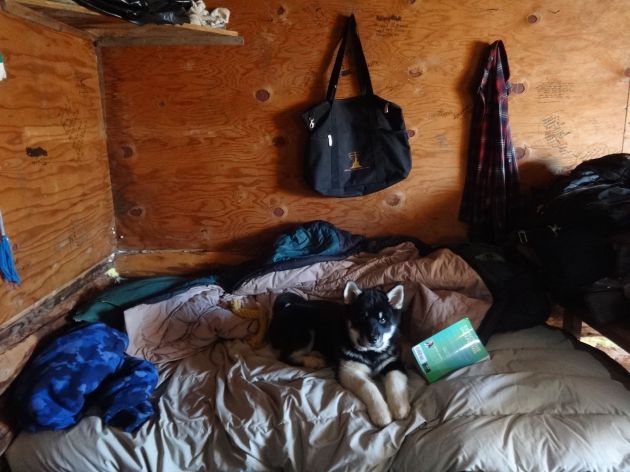
daazhraiimartencabin

Daazhraii relaxing in the morning with a good book at the Marten Lake cabin.

martenlakecabin

A beautiful sight.

martenlakecabin2

I ran out onto the lake in my jammies at twenty below to give the plane a cheerful A-OK that morning. Afterwards, we headed out.

theload

Everything but the kitchen sink – including the toilet (which is a bucket, and which we have to carry because puppies are disgusting)
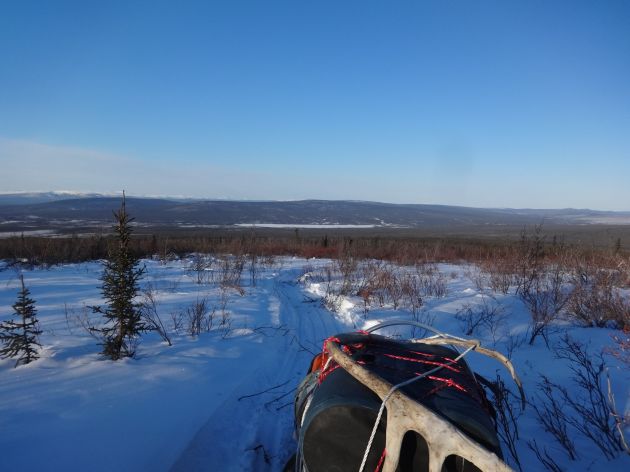
martenlakelookingback

Looking back on Marten Lake from the top of the next ridge.

daazhraiigeoffsledridge

It was another crystal blue day with long views from a rolling ridgeline. We were well-rested and glad, and not much could be finer.

daazhraiidrives

Riding the dash. Or pretending to.

lookingdownonvee

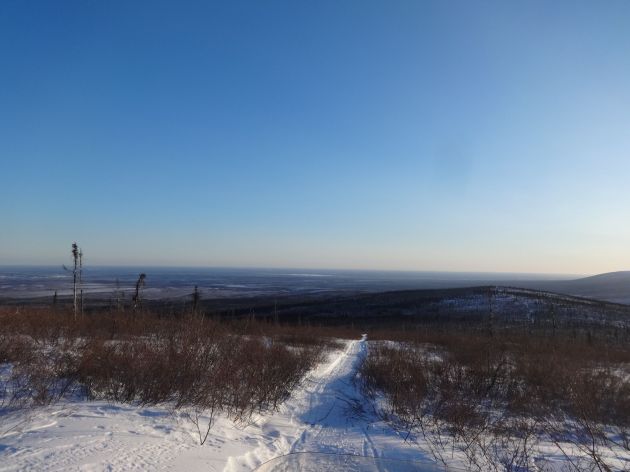
It’s about thirty miles – trail all the way! – from Marten Lake to Venetie. This was taken about halfway, and you can just make out Big Lake in the distance.
viewfromthetop

We reached Venetie around nightfall. Five miles out, I opened my precious toe-warmers, secure in the knowledge that I wouldn’t really need them.